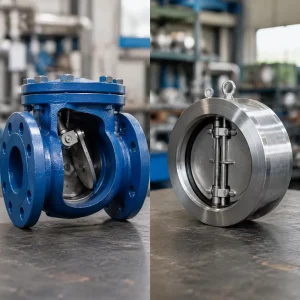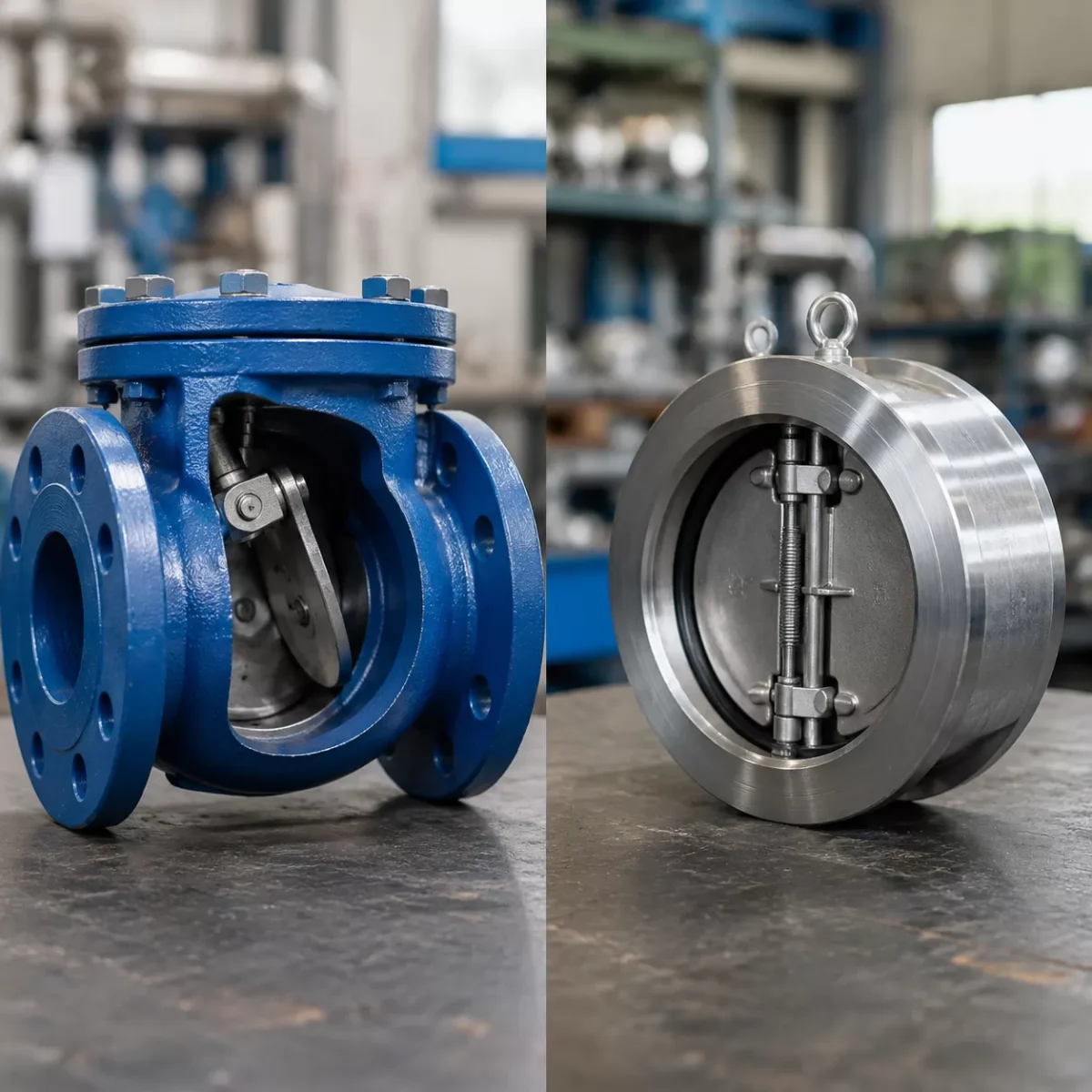
Swing Check Valve vs Wafer Check Valve: Key Differences for Pump and Pipeline Systems
Choosing the right backflow prevention valve is one of the most critical decisions we make when designing efficient industrial piping systems. If you pick the wrong non-return valve (NRV), you risk facing severe pressure loss, devastating water hammer, or premature equipment failure. To protect your pump discharge check valve investment, you must first master how these components operate at a fundamental level.
What is a Swing Check Valve?
A swing check valve relies on a straightforward, robust mechanical design. It features a flanged check valve body housing an internal hinge and disc mechanism that swings open under forward fluid velocity. When the pump runs, the kinetic energy of the flow pushes the disc up and out of the fluid path.
- Full Ported Bodies: The interior is engineered to match the pipe’s full bore diameter, allowing for maximum flow capacity and minimal resistance.
- Top Entry Bonnets: A major advantage for inline pipeline installation. The bolted top cover allows maintenance crews to service, clean, or replace internal parts without breaking the valve out of the pipe spool.
What is a Wafer Check Valve?
A wafer check valve takes a completely different approach, prioritizing an ultra-compact pipeline space footprint. Instead of heavy flanged connections, this slim profile design is clamped directly between pipe flanges, utilizing a single disc or dual plate wafer check valve layout.
- Short Face-to-Face Dimensions: These valves drastically reduce the weight and physical space required in tight manifold skids.
- Spring-Assisted Closure: Unlike gravity-dependent designs, a spring-assisted check valve utilizes mechanical force to snap the disc shut the exact moment fluid deceleration begins, altering reverse flow dynamics to protect vulnerable pump infrastructure.
Swing Check Valve vs Wafer Check Valve: Head-to-Head Comparison
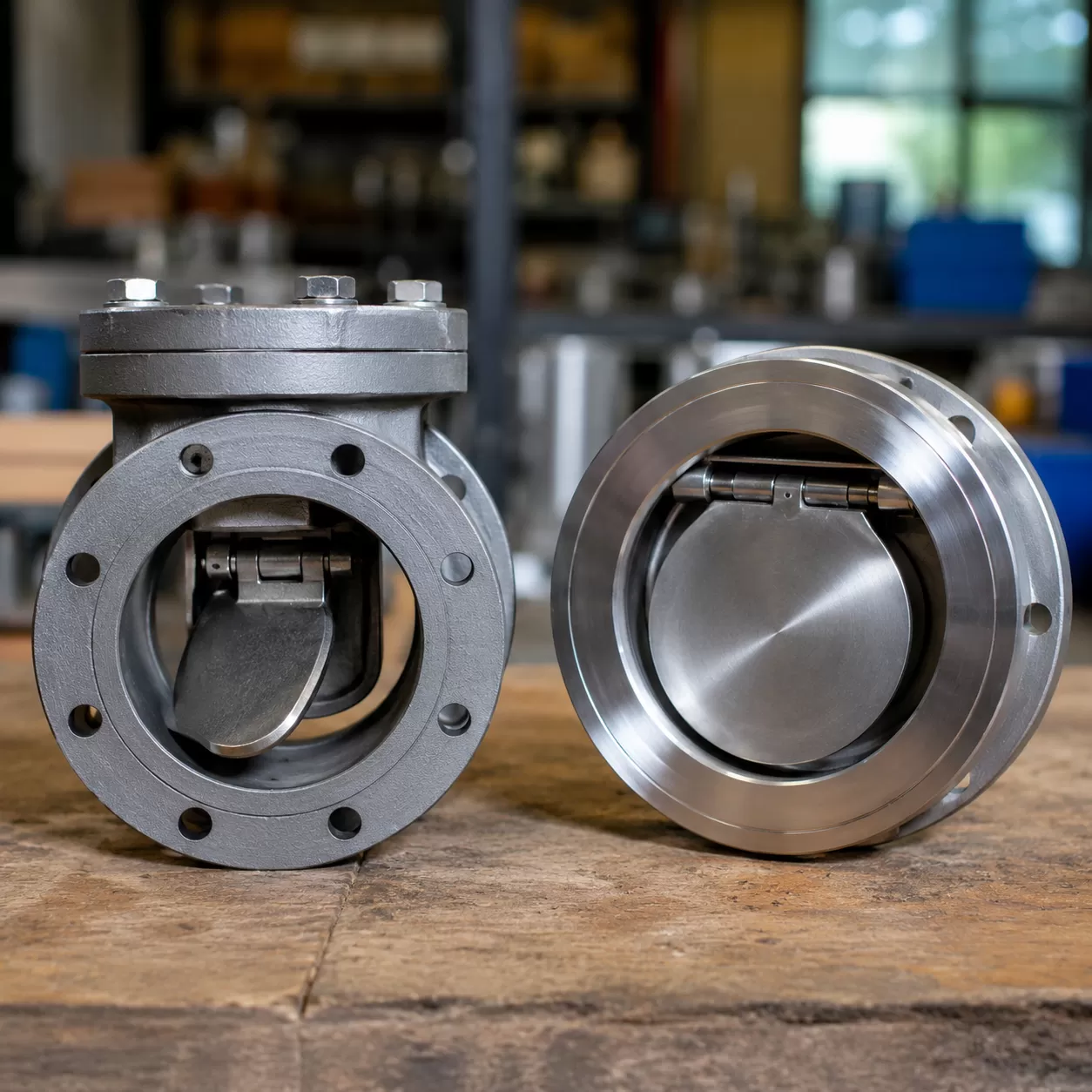
Choosing the right backflow prevention valve comes down to understanding how structural design impacts your daily operations. While both options serve as a critical non-return valve (NRV) to prevent fluid backflow, they perform differently regarding space, flow efficiency, water hammer mitigation, and long-term costs.
Spatial Footprint & Installation Weight
Space and weight constraints often dictate your piping layout. This is where the physical design differences become most apparent.
- Compact Pipeline Space: Wafer check valves feature extremely short face-to-face dimensions. They slide directly between standard pipe flanges, making them the go-to choice for tight footprints and compact skids.
- Pipeline Support Requirements: Swing check valves are bulky, flanged check valve units. Their heavy cast bodies require robust structural supports and hangers to prevent pipe sagging. A wafer valve can reduce installation weight by up to 80% compared to a traditional swing valve, lowering your structural engineering costs.
Flow Characteristics & Pressure Drop
Every component in industrial piping systems impacts your pump efficiency. The internal geometry of these valves directly affects fluid dynamics.
- Full Bore Path vs. Body Obstructions: A swing check valve features a swing-away disc that moves entirely out of the flow stream under forward fluid velocity. This provides a clear, full-bore path. In contrast, even a dual plate wafer check valve leaves its plates and hinge pin directly in the middle of the flow path.
- Pumping Energy Consumption: Because of the internal obstructions in a wafer design, it naturally creates a higher pressure drop (pressure loss). Over years of continuous operation, a higher pressure loss means your pump discharge check valve system requires more electricity to maintain the same flow rate, raising your operational expenditure.
Closing Dynamics & Water Hammer Mitigation
Protecting your pump infrastructure from sudden pressure surges is a primary engineering priority.
- The Physics of Valve Disc Slam: Swing check valves rely on gravity and reverse flow dynamics to close. The disc must travel through a long arc to seal. In high-velocity systems, the fluid reverses before the disc fully closes, causing a violent valve disc slam that shakes the pipeline.
- Spring-Assisted Protection: A spring-assisted check valve, typical of wafer designs, solves this issue. The internal spring actively pushes the plates shut the exact moment flow decelerates, achieving rapid closure before reverse flow can build momentum. This provides superior water hammer mitigation.
Maintenance, Longevity, and Total Cost of Ownership (TCO)
Balancing your initial capital expenditure against long-term upkeep defines the true cost of your valve selection.
- Inline Pipeline Installation & Service: Swing check valves feature a top-entry removable bonnet. This allows for simple inline maintenance; your crew can replace worn seals or discs without cutting the valve out of the line. Wafer check valves cannot be serviced inline and must be completely removed from between the flanges for maintenance.
- CapEx vs. OpEx: Wafer valves offer a significantly lower initial purchase price and cheaper installation labor. However, if your media causes frequent wear, the swing check valve’s ease of service and lower pressure drop can offer a lower total cost of ownership over time.
Quick Comparison: Swing Check vs Wafer Check Valve
| Performance Parameter | Swing Check Valve | Wafer Check Valve |
|---|---|---|
| Face-to-Face Dimensions | Long / Bulky | Ultra-Short / Compact |
| Installation Weight | Heavy (Requires support) | Lightweight (Flange-clamped) |
| Pressure Drop Severity | Minimal / Highly Efficient | Moderate to High |
| Water Hammer Vulnerability | High (Prone to slam) | Low (Spring-assisted rapid close) |
| Inline Maintenance | Yes (Via top bonnet) | No (Requires full removal) |
| Cracking Pressure | Very Low | Low to Moderate (Overcomes spring) |
Table: Swing Check Valve vs Wafer Check Valve
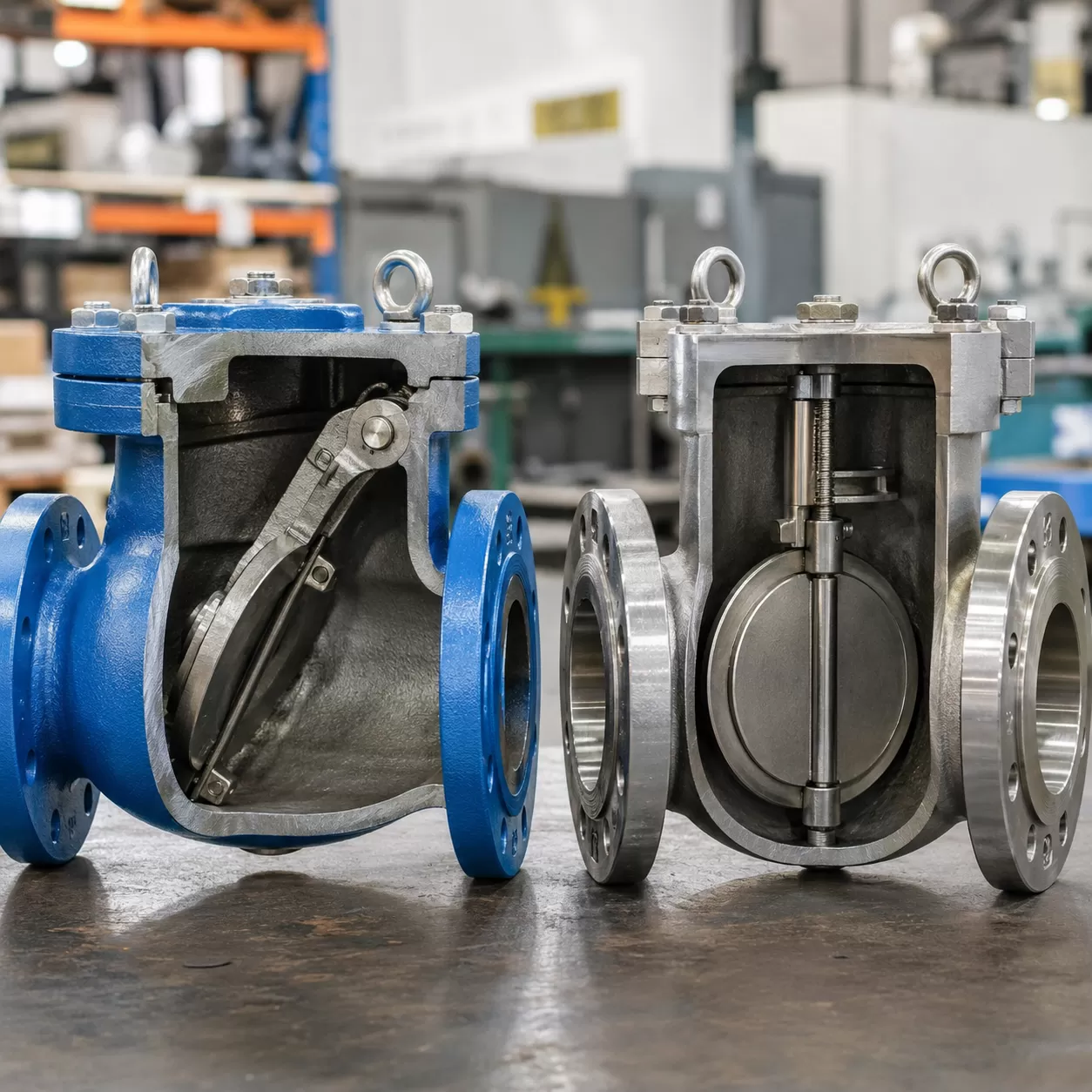
When designing efficient industrial piping systems, choosing the right non-return valve (NRV) comes down to balancing installation space, budget, and fluid dynamics. This quick-reference comparison highlights how a traditional swing check valve stacks up against a compact wafer check valve across critical performance metrics.
| Performance Parameter | Swing Check Valve | Wafer Check Valve / Dual Plate Wafer Check Valve |
|---|---|---|
| Face-to-Face Dimensions | Long, standard flanged check valve footprint | Extremely short, compact pipeline space design |
| Installation Cost & Weight | Heavy structural weight; higher shipping and pipe support costs | Lightweight, slim profile; lower initial capital expenditure |
| Pressure Drop Severity | Minimal pressure loss due to full-bore flow path | Moderate to high pressure drop caused by body obstructions |
| Water Hammer Vulnerability | High risk; long disc travel can cause severe valve disc slam | Low risk; spring-assisted check valve ensures rapid closure |
| Vertical Line Suitability | Poor; relies heavily on gravity and requires specific reverse flow dynamics | Excellent; spring assistance ideal for vertical upward flow |
Choosing between these two backflow prevention valve designs significantly impacts your long-term pump discharge check valve performance and system infrastructure footprint. While a swing check valve excels in low-pressure, high-volume lines, a wafer check valve is the superior option for neutralizing pressure surges in tight spaces.
Critical Applications in Pump and Pipeline Systems
Choosing between a swing check valve vs wafer check valve comes down to your specific system layout, the media you are moving, and your pressure requirements. Both serve as essential backflow prevention valve options, but they excel in completely different environments.
When to Choose a Swing Check Valve
Swing check valves are the traditional workhorses for heavy-duty, high-volume operations. We recommend installing a swing check valve in the following scenarios:
- Low-Pressure, High-Volume Gravity Lines: Perfect for systems that rely on gravity rather than heavy pumping, as the disc swings open easily with minimal fluid velocity.
- Slurry, Wastewater, and Solids: The full-bore design leaves the flow path completely clear. This prevents clogging when handling media with large suspended solids, raw sewage, or thick slurries.
- Systems Requiring Routine Cleaning: If your pipeline requires regular mechanical pigging, rodding, or inline cleaning, the open barrel of a flanged check valve allows cleaning tools to pass through without obstruction.
When to Choose a Wafer Check Valve
Wafer designs are the modern answer to spatial constraints and severe pressure surges. A wafer check valve or dual plate wafer check valve is the right choice for:
- High-Pressure, Multi-Pump Discharge Manifolds: Ideal as a pump discharge check valve where space is tight. They fit snugly between flanges to save valuable footprint on compact skids.
- Clean Water, Gas, and Chemical Pipelines: Excellent for clean industrial piping systems where media lacks heavy solids that could bind the internal springs or dual-plate hinges.
- Vertical Piping Arrays: Unlike standard swing models, a spring-assisted check valve is perfect for vertical lines with upward flow, ensuring positive closure before reverse flow dynamics cause damage.
Quick Application Reference
| Operating Condition | Swing Check Valve | Wafer Check Valve |
|---|---|---|
| Media Type | Slurry, wastewater, large solids | Clean water, gas, chemicals |
| Flow Path | Full bore, unobstructed | Obstructed by plates/springs |
| Piping Orientation | Horizontal preferred | Horizontal or Vertical (upward) |
| Space Constraints | Requires large footprint | Fits in compact pipeline space |
| Risk of Water Hammer | Higher (slow closing) | Lower (spring-assisted check valve) |
Engineering Selection Checklist by Norite
Choosing between a swing check valve vs wafer check valve comes down to your specific system requirements. Before installing a pump discharge check valve or finalizing your industrial piping systems, use this engineering checklist to ensure optimal fluid backflow prevention and long-term reliability.
1. Media Type and Viscosity Analysis
- Thick or Dirty Media: If you are handling slurries, wastewater, or fluids with suspended solids, choose a swing check valve. Its full-bore path prevents clogging.
- Clean Fluids and Gases: For clean water, chemicals, or gas lines, a wafer check valve including a dual plate wafer check valve is ideal.
2. Allowable Pressure Drop Limits
- Low Energy Budgets: Swing check valves offer a clear flow path, minimizing pressure drop and reducing long-term pumping energy costs.
- High-Pressure Systems: If your system can tolerate minor pressure loss, the compact layout of a wafer valve is highly efficient. Evaluate the cracking pressure required to open the valve based on your pump capacity.
3. Spatial Constraints and Piping Orientation
- Compact Pipeline Space: When space is tight, wafer valves are the clear winner. Their short face-to-face dimensions fit perfectly between flanges in crowded skids.
- Vertical vs. Horizontal Runs: Swing check valves rely heavily on gravity and generally require horizontal inline pipeline installation. For vertical lines with upward flow, a spring-assisted check valve wafer style ensures proper seating.
4. System Deceleration and Water Hammer Risk Profile
- High Deceleration Lines: Multi-pump manifolds and high-head systems face a severe risk of valve disc slam.
- Water Hammer Mitigation: Traditional flanged check valve designs like swing checks close slowly, which can cause damaging pressure surges. To protect your pump infrastructure, utilize a spring-assisted wafer design for rapid, quiet closure.
Frequently Asked Questions (FAQs)
Can a swing check valve be installed vertically?
Yes, but only in vertical lines with upward fluid flow. You cannot use a swing check valve in a downward flow configuration because gravity will keep the valve disc open, completely defeating the purpose of fluid backflow prevention. For vertical setups, ensure the water pressure is strong enough to fully open the heavy flapper.
Which valve has a higher pressure drop?
A wafer check valve generally creates a higher pressure drop than a swing check valve. Swing check valves feature a full-bore path where the disc swings completely out of the flow stream, minimizing resistance. Wafer styles, especially a dual plate wafer check valve, keep the plates and center pin directly in the media path, which increases flow restriction and overall pressure loss.
How does a dual plate wafer check valve reduce water hammer?
A dual plate wafer check valve excels at water hammer mitigation thanks to its spring-assisted check valve design. Instead of waiting for reverse flow to push the valve shut, the internal springs force the dual plates closed the exact moment fluid velocity drops to zero. This rapid response prevents valve disc slam before the fluid can reverse direction and hammer the pump discharge check valve assembly.
What are the typical face-to-face dimensions for wafer check valves?
Wafer check valves are designed for a compact pipeline space. Their face-to-face dimensions are significantly shorter than a standard flanged check valve, often measuring just one-fourth to one-eighth of the length of a swing valve. This ultra-slim profile allows them to slide easily between standard pipe flanges in tight industrial piping systems.
Need Help Selecting the Right Check Valve?
For pump stations, wastewater lines, municipal water systems, or compact pipeline projects, Norite can help you compare valve structure, pressure drop, water hammer risk, and maintenance requirements. You can also review our industrial valve price guide to better understand how valve type, size, material, and installation design affect long-term project cost.