

An axial flow pump is often a candidate for moving large volumes of stormwater at low head. A mixed flow pump can be a candidate when substantial flow must be delivered at a higher head. The final choice depends on the specific pump curve, the station’s operating range, intake conditions, and debris characteristics—not a universal head threshold.
For municipal contractors, EPC buyers, and consulting engineers, an axial flow vs mixed flow pump comparison should answer one practical question: which proposed model can deliver the required flow throughout the project’s specified operating conditions?
NORITE’s urban drainage and sewage treatment systems bring together pumping, screening, isolation, and discharge equipment. Pump selection should account for those interfaces from the start.
Preparing a stormwater pumping project? Send NORITE your required flow, upstream and downstream water levels, and station drawings for an initial equipment selection review.
Axial Flow vs Mixed Flow Pump: What Is the Difference?
An axial flow pump moves water through the impeller mainly parallel to the shaft. Its propeller-style hydraulic design is commonly considered for high-volume, low-lift duties.
A mixed flow pump moves water through the impeller in a direction with both axial and radial components. Its hydraulic design bridges axial and radial flow arrangements and can cover higher-head duties than comparable low-head propeller pump designs.
The terms describe hydraulic design. They do not establish installation method, corrosion resistance, solids passage, or suitability for untreated sewage.
| Selection factor | Axial flow pump | Mixed flow pump | What the buyer should check |
|---|---|---|---|
| Flow through the impeller | Mainly parallel to the shaft | Combines axial and radial directions | Sectional drawing and hydraulic designation |
| Typical selection direction | Large flow with relatively low head | Substantial flow with a higher head requirement | Actual model coverage at the required flow |
| Performance curve | Many propeller designs have steep curves and restricted low-flow operation | Curve shape varies with the hydraulic design | H–Q curve and permitted operating range |
| Efficiency | Depends on the selected model and operating point | Depends on the selected model and operating point | Efficiency across the expected duty range |
| Motor loading | Must be checked throughout the operating range | Must be checked throughout the operating range | Absorbed power, starting conditions, and motor rating |
| Solids and fibers | Requires model-specific assessment | Requires model-specific assessment | Passage geometry and screening conditions |
| Intake requirements | Sensitive to approach flow and adequate submergence | Also requires suitable intake conditions | Pump bay dimensions and water levels |
Use this comparison to shortlist hydraulic types. Request model-specific data before approving either option.
NORITE’s ZQB/HQB submersible axial-flow and mixed-flow pump range provides a starting point for discussing drainage duties. The proposed model, configuration, and performance curve must match the project specification.
Start Stormwater Pump Selection with the Required Duty
A duty point states the required flow and head under a defined condition. The actual operating point occurs where the pump curve intersects the system curve.
Before requesting a quotation, define:
- Minimum, design, and peak station inflow.
- Required station discharge capacity and capacity per operating pump.
- Lowest and highest operating water levels in the intake or pump well.
- Receiving river, canal, or tidal water levels.
- Number of operating and standby pumps.
- Debris, sediment, and wastewater content.
Keep station capacity separate from per-pump capacity. A request for “6,000 m³/h” is incomplete if it does not say whether this is the station total or the requirement for each unit.
Similarly, maximum catalog flow and maximum catalog head usually represent different points on a curve. They should not be combined into a guaranteed duty point.
Compare Total Head, Not Just Vertical Lift
For a station transferring water between open water surfaces, total head includes the water-level difference and hydraulic losses through the pumping route. Pressurized receiving systems require an additional pressure-head assessment.
Relevant losses can include the intake passage, riser or discharge pipe, bends, transitions, valves, and outlet arrangement. Define the calculation boundaries so losses are counted once.
For a high flow low head pump, relatively small component losses can be a significant part of the head requirement. A restrictive discharge arrangement may change which pump models remain suitable.
If the outfall includes a flap valve, obtain its opening and head-loss characteristics. Include receiving-water conditions when reviewing discharge performance.
Illustrative Head Check
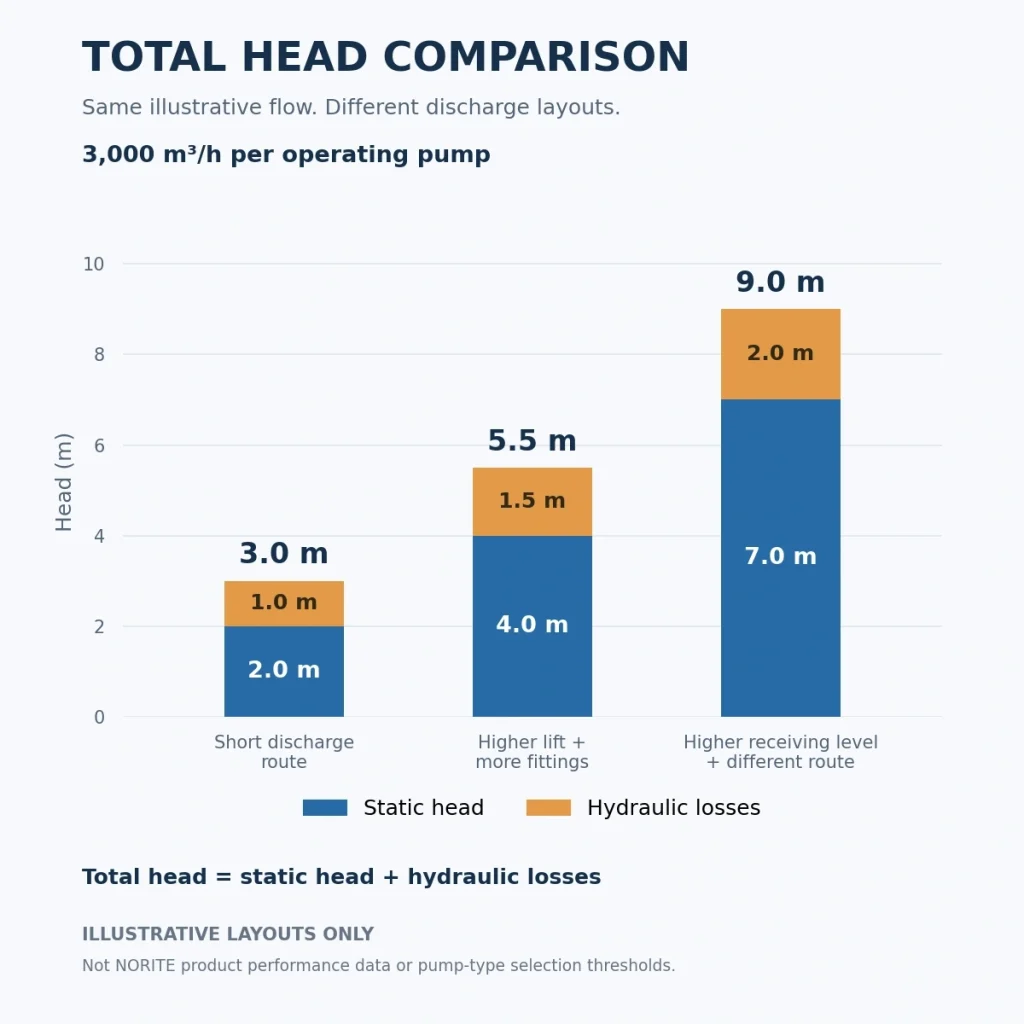
The following values are hypothetical and demonstrate how to organize a comparison. They are not NORITE performance data or a model recommendation.
Assume a required flow of 3,000 m³/h per operating pump, with separate discharge arrangements under consideration:
| Proposed condition | Static water-level difference | Assumed hydraulic losses at the stated flow | Required head for review | Next step |
|---|---|---|---|---|
| Short discharge route | 2.0 m | 1.0 m | 3.0 m | Check low-head axial candidates and any mixed-flow models covering this duty |
| Higher lift with additional fittings | 4.0 m | 1.5 m | 5.5 m | Compare actual curves of both shortlisted hydraulic types |
| Higher receiving level and a different discharge route | 7.0 m | 2.0 m | 9.0 m | Confirm which models deliver the required flow within their permitted range |
The loss values differ because the assumed discharge arrangements differ. A rise in river level alone does not justify assigning a different friction loss at the same flow through unchanged pipework.
These figures do not establish a head boundary between axial and mixed flow pumps. Selection still requires curves for the proposed speed and hydraulic configuration.
Use a Multi-Condition Pump Selection Matrix
A stormwater station rarely has only one relevant operating condition. Compare each candidate against the project’s specified combinations of intake level, receiving-water level, and pump operation.
| Condition to review | Effect on the station | Evidence required from each candidate |
|---|---|---|
| Normal receiving level and design inflow | Establishes the main selection duty | Required flow, efficiency, and absorbed power at the operating point |
| High river level with low intake level | Can increase static head | Delivery capacity and permitted operation at the higher-head condition |
| Low receiving level with high intake level | Can reduce static head | Maximum resulting flow, motor loading, and operating limits |
| Lowest permitted intake level | Reduces available submergence | Intake requirements and cavitation assessment |
| Multiple pumps running | Changes combined capacity and common-pipe losses | Combined pump and system curves |
| One required unit unavailable | Reduces available pumping capacity | Remaining capacity against the project’s redundancy requirement |
| Partially obstructed intake screening | Adds intake restriction and may lower downstream water level | Screening head loss and resulting intake conditions |
Evaluate the water-level combinations required by the project design basis. Not every extreme occurs simultaneously.
For pumps sharing a discharge system, do not simply multiply one unit’s catalog capacity by the number of pumps. Determine the combined operating point using the pump curves and system resistance.
Have a nominal duty point but incomplete water-level information? Share your available drawings and operating conditions with NORITE so the missing selection inputs can be identified before a model is proposed.
Check Curves, Efficiency, and Motor Loading Together
For each shortlisted pump, request the H–Q, efficiency, absorbed-power, and suction-performance data applicable to the proposed configuration. Ask the supplier to identify continuous operating limits and any restricted regions.
A pump that meets the design duty may move into an unsuitable operating region under another water-level condition. Check the full range rather than approving a model from one marked point.
Motor power also needs a separate review. Many axial-flow designs can have high absorbed power at low flow; a lower discharge rate does not necessarily mean a lighter motor load. Confirm the proposed starting arrangement and maximum absorbed power with the supplier.
Neither hydraulic type is automatically more energy efficient. Compare proposed models at matched flow and head conditions, then consider how often the station operates at each condition.
If evaluating NORITE’s QS Series submersible axial flow pumps, request the current model-specific curve and dimensional drawing for the intended duty. Use those documents to confirm suitability.
Match Debris Screening and Intake Conditions to the Pump
Stormwater may carry leaves, plastic, branches, grit, and fibrous waste. A mixed-flow impeller is not automatically a non-clog sewage impeller, and an axial-flow pump is not automatically suitable for all unscreened runoff.
Ask for the proposed pump’s solids-passage information and media limitations. Review long fibers separately from nominal particle size: material that fits through an opening can still wrap around rotating components.
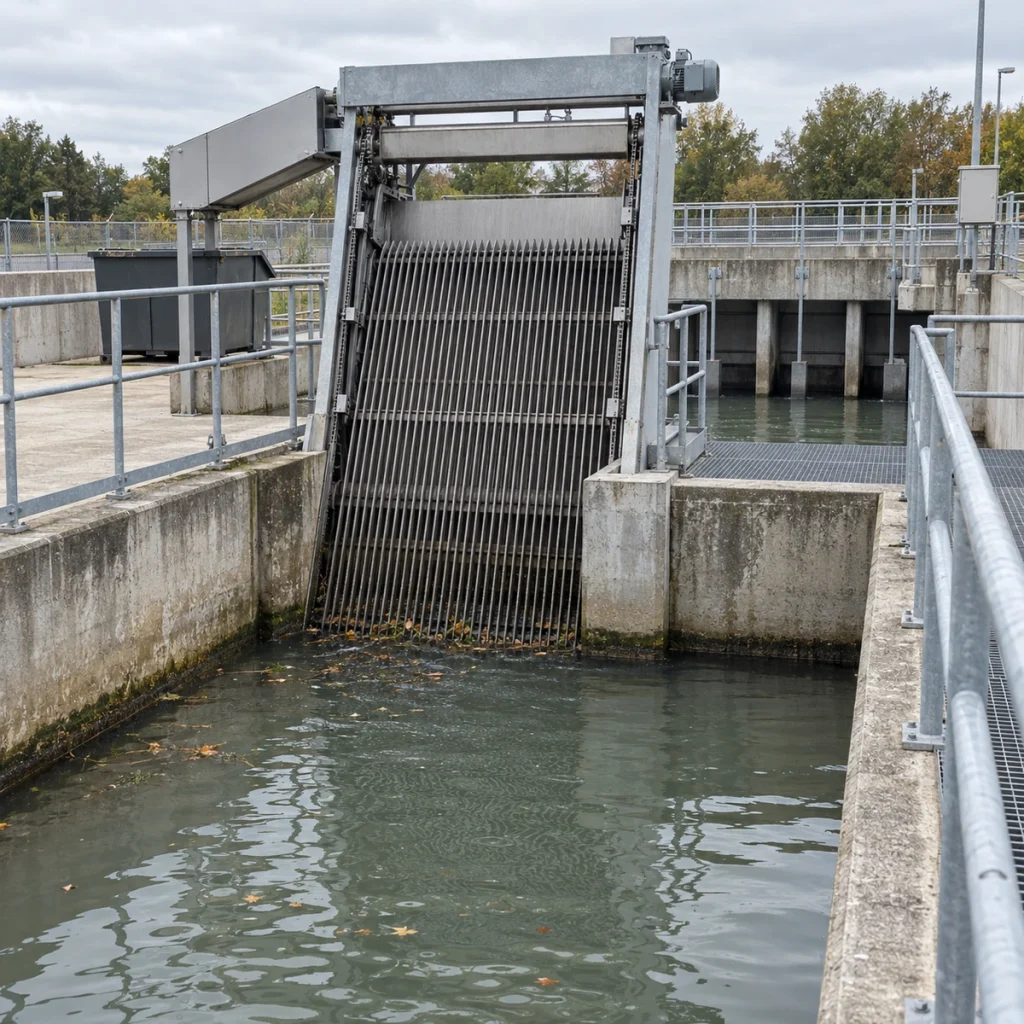
Where upstream screening is specified, coordinate the automatic rotary bar screen cleaner with the pump selection. Provide debris characteristics, peak flow, channel dimensions, and allowable water-level difference across the screen.
Intake geometry also matters. Uneven approach flow, vortices, and air entrainment can undermine otherwise suitable equipment.
Submit a plan and section showing pump spacing, intake direction, floor and wall clearances, water levels, and any upstream bends or obstructions. Obtain model-specific submergence requirements; large or unusual arrangements may require further hydraulic verification.
Verify the Proposed Model Before Purchase
Use a common review sheet so competing offers can be assessed under the same conditions.
| Supplier document or confirmation | What to verify |
|---|---|
| Hydraulic designation | Whether the offered model is axial or mixed flow; confirm against the sectional drawing |
| Performance curves | Flow and head at the specified speed and hydraulic configuration |
| Operating-range statement | Which project conditions are permitted for continuous operation |
| Power and motor data | Maximum absorbed power, rated supply, starting method, and cooling conditions |
| Intake requirements | Submergence, clearances, pump bay geometry, and suction-performance requirements |
| Media information | Solids passage, fiber limitations, sediment, temperature, and corrosion conditions |
| Installation drawing | Dimensions, lifting access, discharge connection, and civil interfaces |
| Testing proposal | Guaranteed points, acceptance criteria, and applicable test standard |
| Supply scope | Pump, motor, cables, sensors, installation components, and separately quoted equipment |
Do not approve a pump solely from a series name, diameter, or motor rating. The final order should identify the configuration supporting the reviewed curves and drawings.
What to Send for a Stormwater Pump Quotation
For a new station or equipment replacement, provide:
- Project location and whether the medium is stormwater, screened wastewater, or combined-sewer flow.
- Minimum, design, and peak flow, clearly separated into station and per-pump requirements.
- Intake and receiving-water levels using a common elevation datum.
- System curves, or pipe dimensions, routing, fittings, and outlet details for review.
- Pump bay drawings, lowest operating level, and installation constraints.
- Debris and sediment information, including upstream screening.
- Operating and standby pump quantities, power supply, and control requirements.
- Required materials, technical documents, testing, destination, and delivery date.
If some information is preliminary, identify it as preliminary. This allows the quotation to distinguish confirmed requirements from assumptions that need review.
Frequently Asked Questions
Is there a fixed head limit for choosing an axial flow pump instead of a mixed flow pump?
No universal threshold applies to every model. Use flow and head to shortlist candidates, then check their curves, operating limits, power requirements, and intake conditions.Is a mixed flow pump always better for stormwater containing solids?
No. Hydraulic type alone does not establish solids or fiber handling. Confirm passage geometry, media limitations, screening, and the proposed pump’s suitability for the actual debris.Can an axial flow pump be replaced with a mixed flow pump in an existing station?
Potentially, but replacement requires a hydraulic and installation review. Check duty coverage, intake geometry, discharge interfaces, motor loading, lifting access, and controls before approving a substitute.What if the receiving river level changes significantly?
Specify the relevant river and intake levels, then review candidate performance across those conditions. A pump selected only at the normal river level may not provide the required capacity during high-water discharge.
Request Pump Selection for Your Stormwater Station
NORITE provides equipment options for municipal drainage projects, including pumps, screening equipment, gates, and discharge components. Review the integrated drainage and wastewater solution alongside your equipment requirements.
Request a project quotation with your flow and head requirements, water levels, drawings, equipment quantities, destination, and required delivery date. Include any specified materials, testing, accessories, or technical documents so the proposed scope can be reviewed against your project.





