The Physics of the Problem: Backflow and Water Hammer in Pump Stations
When a pump suddenly shuts down, your entire piping system is immediately put at risk. Managing a municipal water system or an industrial plant means understanding that the split second following a power failure is critical. Without the right check valve for pump station protection, the resulting hydraulic shock can destroy your infrastructure.
Anatomy of a Pump Trip Transient
A pump trip transient begins the exact moment power to the pump motor cuts out. The forward momentum of the fluid does not stop instantly, but the pump stops pushing it.
- Low-Pressure Wave: A low-pressure wave travels down the pipeline away from the pump.
- The Void: The fluid column stretches, slows down, and eventually comes to a dead stop.
- The Reversal: Gravity and system head pressure force the entire volume of water to race backward toward the defenseless pump.
The Mechanism of Backflow
Reverse flow prevention is your first line of defense. When the forward energy of the fluid drops to zero, the water reverses direction almost instantly.
If your pump station check valve fails to close before this reversal gains speed, the fluid forces its way backward through the pump. This backflow causes the pump impellers to spin backward, damaging the motor, stripping gears, and draining millions of gallons of treated water back into the wet well.
What Causes Check Valve Slam?
Valve slam is the direct result of a slow-closing valve meeting fast-moving reverse flow.
[Fluid Reverses Direction] -> [High Velocity Reverse Flow Hits Open Disc] -> [Disc Slams Shut Instantly] -> [Water Hammer Shockwave Generated]
If a valve disc takes too long to respond to fluid deceleration, the backward-rushing water catches the disc open and slams it violently against the valve seat. This sudden, instantaneous stop converts the kinetic energy of the moving water into a high-pressure shockwave. This phenomenon is known as a water hammer, and it sends destructive pressures rippling back and forth through your pipeline.
The Operational and Financial Costs
Ignoring these hydraulic shocks leads to catastrophic system failures and budget-draining repairs.
| System Failure Component | Direct Operational Impact | Financial Consequence |
|---|---|---|
| Pipeline Ruptures | Main breaks, localized flooding, and immediate service termination. | Expensive emergency repair crews and EPA fines. |
| Flange & Joint Leaks | Weakened seals and ongoing water loss throughout the network. | Increased pumping costs and water waste. |
| Pump Damage | Broken shafts, cracked casings, and ruined thrust bearings. | Premature equipment replacement and extended downtime. |
Investing in a high-performance water hammer check valve isn’t just about system safety; it is about protecting your bottom line from preventable disasters.
Evaluating Check Valve Types for Water Hammer Control
Choosing the right check valve for pump stations is the difference between a smooth-running system and a pipe-bursting disaster. Not every valve handles fluid deceleration the same way. We look for designs that minimize “slam” and manage pressure spikes before they compromise your infrastructure.
1. Traditional Swing Check Valve
This is the old-school industry standard. While reliable for simple low-head systems, the swing check valve has a major drawback: it closes slowly. In a pump trip, the disc has a long travel distance, often slamming shut only after reverse flow has already started, which triggers a massive water hammer.
2. Dual Plate Check Valve (Wafer Check Valve)
The dual plate check valve, often called a wafer check valve, uses two spring-loaded plates hinged in the center. Because the plates are lighter and have a shorter distance to travel, they respond much faster than a single swing disc. This design is compact, fits between flanges easily, and is a solid middle-ground for moderate pressure systems.
3. Silent (Spring-Assisted) Poppet Check Valve
For those looking for a true non-slam check valve, the silent poppet is a top-tier choice. It features a center-guided stem with a heavy-duty spring. The spring forces the valve shut the instant flow velocity hits zero—before the water can reverse direction. This “always closed” default effectively kills the kinetic energy that causes noise and vibration.
4. Nozzle Check Valve
The nozzle check valve is the gold standard for critical high-head pump stations. It uses a streamlined internal geometry and a short-stroke, spring-loaded disc. This allows for incredibly fast closure speeds and minimal pressure drop. It’s the most effective tool we have for complete hydraulic shock mitigation in complex piping networks.
5. Slow Closing Check Valve
In specific scenarios where you want to gradually bleed off pressure, a slow closing check valve equipped with a hydraulic dashpot or bypass is used. Unlike the previous types, this valve is engineered to close at a controlled rate, preventing a sudden stop of the fluid column.
| Valve Type | Closure Speed | Water Hammer Risk | Best Use Case |
|---|---|---|---|
| Swing Check | Slow | High | Low-pressure gravity lines |
| Dual Plate | Moderate | Medium | Space-constrained layouts |
| Silent Poppet | Fast | Very Low | High-rise buildings/HVAC |
| Nozzle Check | Ultra-Fast | Negligible | Large municipal pump stations |
| Slow Closing | Controlled | Low | Long transmission pipelines |
Selecting the right hardware is only half the battle; ensuring your metal seat gate valve is properly positioned upstream for maintenance is equally vital for a professional pump station check valve installation.
Critical Engineering Selection Criteria for a Pump Station Check Valve

Choosing the right pump station check valve isn’t about matching pipe diameters. It requires a deep dive into your pipeline’s unique hydraulics to prevent catastrophic failure. When we design and spec systems for U.S. municipal and industrial networks, we evaluate four critical engineering benchmarks.
System Head and Pipeline Profile
The physical layout of your pipeline dictates how fluid behaves when power cuts out. High-head systems (where the pump pushes water vertically up a steep incline) experience incredibly rapid flow deceleration.
- High-Head Systems: The column of water reverses almost instantly when the pump stops. You need a fast-acting water hammer check valve—like a spring-assisted or nozzle design—to close before that reverse flow gains momentum.
- Low-Head, Long Horizontal Runs: The water column takes longer to slow down and reverse. While less prone to violent slam, these profiles are highly susceptible to column separation, requiring careful coordination with air valves for municipal pipelines to manage transient pressures.
Closure Speed vs. Pipeline Reflection Time
To achieve true hydraulic shock mitigation, the valve disc must fully seat before the reverse flow velocity can build up. This comes down to a race against the pipeline reflection time ($t$).
$$t = frac{2L}{a}$$
Where:
- $L$ = Length of the pipeline
- $a$ = Speed of the pressure wave (acoustic velocity)
If your valve closing speed is slower than $t$, the returning pressure wave hits an open or partially open disc, causing severe check valve slam. For short pipelines with fast reflection times, a rapid-closing spring-assisted check valve or a high-performance nozzle check valve is mandatory to cut off reverse flow in milliseconds.
Flow Velocity and Pressure Drop
Every piece of hardware introduces friction. Over a pump’s lifespan, excessive pressure drop translates directly into wasted energy and higher utility bills.
| Valve Type | Dynamic Response | Pressure Drop (Head Loss) | Best Used For |
|---|---|---|---|
| Swing Check Valve | Slow | Low | Low-velocity, stable flows |
| Wafer Check Valve (Dual Plate) | Medium | Moderate | Compact spaces, medium head |
| Nozzle Check Valve | Extremely Fast | Minimal to Moderate | High-head, critical surge protection |
| Slow Closing Check Valve | Controlled | Low | Long pipelines with heavy surge tanks |
We look for a balance: the valve must stay fully open and stable at your normal operating fluid deceleration rates, yet offer low dynamic drag to keep your pipeline pump operating at peak efficiency.
Media Characteristics
The nature of the fluid determines the valve’s internal geometry and material build.
- Clean Water & Municipal Distribution: Allows for tight-tolerance, high-performance designs like dual plate or nozzle valves with elastomer seats for drop-tight reverse flow prevention.
- Wastewater and Sludge: Demands clear-path designs. Avoid spring-assisted or multi-plate valves in these environments, as solids will wrap around the internals, causing clogging and preventing the valve from sealing completely.
Professional Installation Best Practices for Maximum Protection
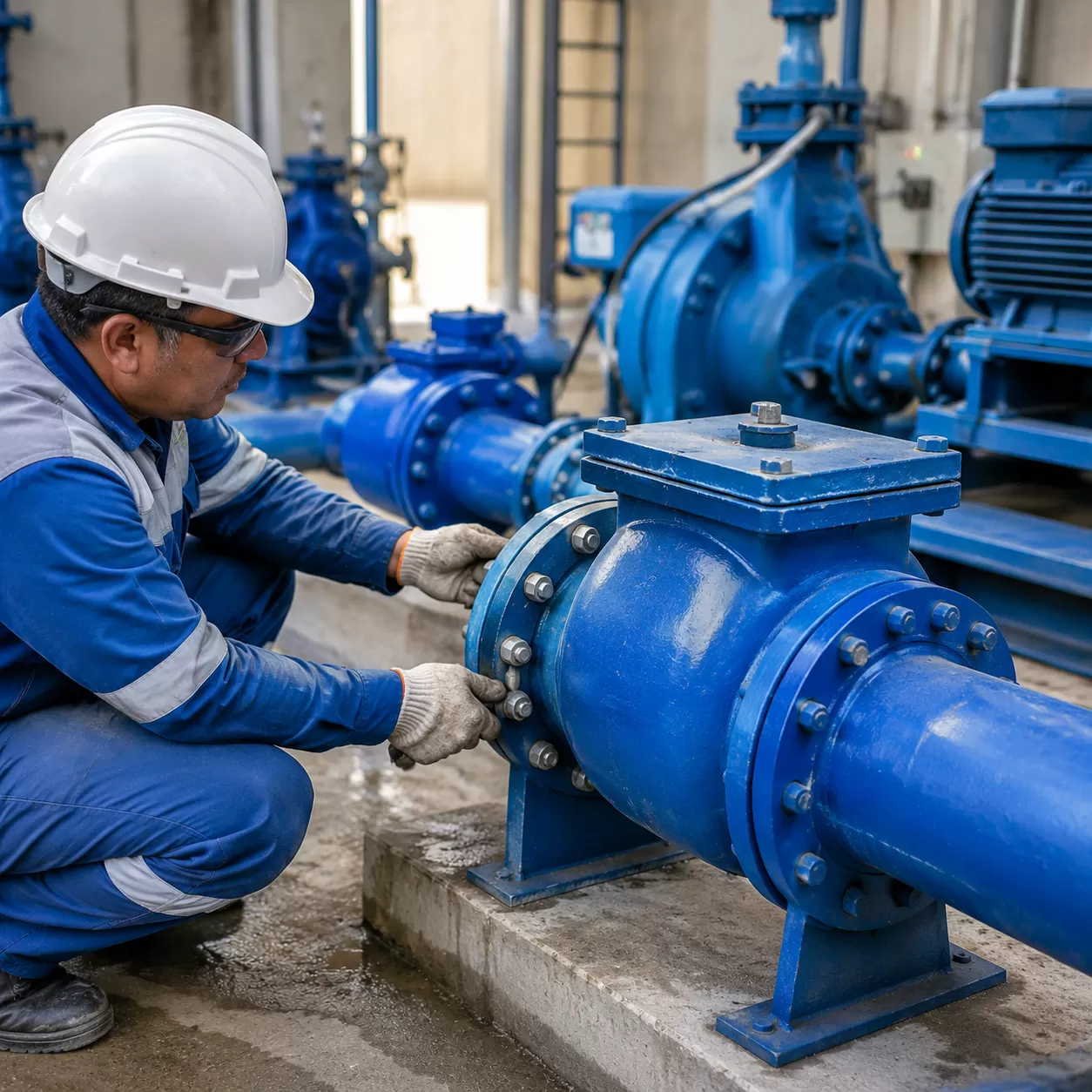
Getting the right pump station check valve is only half the battle. If you don’t install it correctly, even the best water hammer check valve will fail prematurely or slam shut. Proper field placement is what guarantees long-term reverse flow prevention and keeps your pipeline quiet.
The Golden Rule of Placement
Never bolt a valve directly to a pump discharge flange or a pipe bend. To ensure a smooth fluid deceleration profile, always install the valve at a distance of at least 5 to 10 pipe diameters downstream from any turbulence-producing component like pumps, elbows, or butterfly valve types. This straight run stabilizes the water before it hits the disc, preventing premature wear on the internal mechanisms.
Managing Fluid Turbulence
Turbulent flow causes the valve disc to chatter, which quickly destroys the seats and bearings. In discharge piping installation, keeping the flow stream linear is critical.
- Avoid Close Proximity to Tees: High-velocity cross-flows cause uneven forces on the valve mechanism.
- Use Concentric Reducers: If you must change pipe sizes, use concentric reducers before the straight run to keep the velocity profile symmetrical.
Orientation Limitations
Not every non-slam check valve can handle vertical flow.
- Horizontal Lines: Ideal for almost all styles, including traditional swing options and dual plate variants.
- Vertical Lines (Flow Up): Requires a spring-assisted check valve or a nozzle check valve to ensure the force of gravity works with the spring mechanism for a positive seal.
- Vertical Lines (Flow Down): Avoid this setup entirely. Gravity will prevent the valve from closing fast enough, leading to massive backflow issues.
System Pairing
For complete isolation during maintenance, always pair your check valve with a reliable shutoff valve. Placing a heavy-duty isolation valve, such as a resilient seated gate valve, downstream of the check valve allows you to safely isolate and service the pump station check valve without draining the entire pipeline network.
Maintenance and Troubleshooting Diagnostics
Ignoring your pump station check valve until it fails is a recipe for catastrophic pipe bursts and flooded facilities. When managing high-flow systems—whether utilizing standard commercial setups or heavy-duty configurations like the Norite QWX high lift sewage pump—spotting early warning signs saves thousands of dollars in emergency repairs.
Here is how to diagnose and fix the most common check valve failures before they compromise your system.
Symptom: Auditory Thumping or Vibration Upon Pump Shutdown
If you hear a loud, metallic thud or feel the ground vibrate when the pump cycles off, you are dealing with classic check valve slam. This is a direct symptom of severe hydraulic shock mitigation failure.
- The Cause: The valve disc is closing too slowly. By the time the disc attempts to seat, the fluid has already reversed direction and accelerated, slamming the disc shut violently.
- The Fix: Inspect the internal spring tension. If you are using a swing check valve, consider upgrading to a spring-assisted check valve or a nozzle check valve to ensure faster fluid deceleration and zero-slam closure.
Symptom: Increased Leakage or Reverse Pump Rotation
When a pump shuts down but the shaft starts spinning backward, or you notice pressure dropping rapidly downstream, your reverse flow prevention mechanism has failed.
- The Cause: Debris (such as rags, wipes, or mineral scale) is wedged in the valve seat, or the elastomer seals are completely worn out.
- The Fix: Immediately isolate the line and inspect the seating surfaces. For high-solids applications, ensure your wafer check valve or dual plate check valve is rated for the media to prevent recurring clog-induced bypass.
The Norite Preventive Maintenance Protocol
To maximize the lifespan of your water hammer check valve and protect your discharge piping installation, we recommend implementing this strict three-step protocol every six months:
| Maintenance Step | Action Item | Target Metric |
|---|---|---|
| 1. Visual & Auditory Inspection | Check for external packing leaks, unusual ticking noises during operation, or line vibration. | Zero leakage; smooth, quiet operation. |
| 2. Internal Component Check | Open the inspection cover to check spring elasticity, hinge pin wear, and disc alignment. | Replace springs if they lose >10% of original tension. |
| 3. Flush & Clean | Clear out accumulated solids around the seat and disc pivot points. | Ensure 100% unrestricted disc movement. |