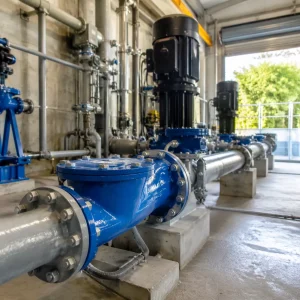
If you have ever stood inside a municipal or industrial pump station when a pump trips, you know the feeling.
That sudden, metallic bang echoing through the facility isn’t just noise. It is a hydraulic shock wave tearing down your pipeline at thousands of feet per second.
Left unchecked, this water hammer does real damage—shattering pump shafts, cracking pipe welds, and blowing out expensive gaskets.
The worst part? Your traditional swing check valve is likely making it worse. Because these valves rely on gravity and flow reversal to close, they often slam shut after the liquid column has already reversed direction, acting like a steel wall against a moving liquid sledgehammer.
But it doesn’t have to be this way.
By upgrading to a spring assisted check valve, you can stop fluid transients in their tracks. In this technical playbook, we are going to break down exactly how an axial flow silent check valve mitigates severe pressure surges, eliminates valve disc flutter, and protects your high-cost centrifugal pump discharge line infrastructure.
Let’s dive right into the physics of zero-slam engineering.
Why Do Pumping Systems Suffer from Water Hammer?
Ever heard a loud, violent bang in your pipelines after a pump shuts down? That is water hammer, and it is one of the most destructive forces in a pumping system transient.
When a centrifugal pump stops, the forward fluid velocity drops to zero almost instantly. This sudden fluid velocity deceleration creates a massive physical problem. The moving column of water has momentum; when it stops abruptly, that kinetic energy has to go somewhere. The result is a hydraulic shock wave that travels backward through the pipe at thousands of feet per second, pounding against your equipment.
The Danger of Traditional Swing Check Valves
Standard swing check valves are the primary culprit behind severe water hammer check valve issues.
Traditional swing check valves rely entirely on gravity and reverse flow to push the heavy valve disc closed. Because the disc has to travel a long distance to seal, a massive amount of reverse flow develops before the valve actually shuts.
- The Slam Effect: The backward-rushing water catches the open disc and slams it violently into the valve seat.
- The Damage: This sudden halt of reverse flow causes catastrophic pressure surge spikes and severe pipeline vibration.
- The Cost: Over time, this constant pounding ruptures pipe joints, destroys gaskets, and cracks expensive pumps.
To protect your infrastructure, relying on a slow-closing mechanism is a major risk. True pressure surge mitigation requires a valve designed to close before the water column can reverse direction. That is where a dedicated non slam check valve becomes essential for industrial piping safety.
The Engineering Solution: What Is a Non-Slam Check Valve?
When you are fighting water hammer in high-pressure pump stations, standard valves just don’t cut it. That is where the non-slam check valve comes in. Unlike traditional valves that rely on gravity or reverse flow to slam shut, this engineered solution is built specifically for pressure surge mitigation and reverse flow prevention before the trouble even starts.
Definition & Core Purpose
At its core, a non-slam check valve—often referred to as a spring assisted check valve—is designed to close before the column of water in your pipeline can reverse direction.
The primary purpose is simple: eliminate the destructive hydraulic shock wave that occurs when moving water hits a suddenly closed gate. By shutting down the moment forward fluid velocity deceleration hits zero, it protects your centrifugal pump discharge line, stops severe pipeline vibration, and keeps your entire infrastructure safe.
Anatomy of a Silent Operator
We build these valves to handle the toughest industrial piping safety standards in the United States. The internal design is streamlined to minimize pressure drop while maximizing response speed.
- The Spring: The heart of the valve. It actively forces the disc closed as flow slows down, rather than waiting for gravity.
- The Disc: A lightweight, low-inertia disc that moves along a central shaft for rapid response.
- The Guide Shaft: Ensures perfect alignment so the disc seals tightly every single time without binding.
- The Seat: Precision-machined to ensure a drop-tight seal immediately upon closure.
How It Works: Step-by-Step Dynamics
Understanding the internal mechanics shows exactly why this design stops water hammer in its tracks.
| Phase | Flow Status | Valve Action | System Impact |
|---|---|---|---|
| 1. Pump Start | Flow begins | Fluid overcomes the cracking pressure and opens the disc. | Smooth, unobstructed forward flow. |
| 2. Normal Operation | Full velocity | The disc remains fully open and stable. | Minimal pressure drop across the station. |
| 3. Pump Shutdown | Flow decelerates | The internal spring senses the drop in pressure and pushes the disc toward the seat. | Pre-emptive closing action begins. |
| 4. Zero Flow | Flow hits zero | The valve achieves flow reversal closure at the exact millisecond forward motion stops. | Pumping system transient is entirely avoided; no slam occurs. |
Swing Check Valve vs. Non-Slam Check Valve: Comparative Performance

When protecting your pump station from destructive hydraulic shock waves, the type of check valve you install on the centrifugal pump discharge line makes all the difference. Traditional swing check valves have served the industry for decades, but modern high-head systems demand the advanced pressure surge mitigation of the Norite non-slam check valve.
Here is how the two technologies stack up across critical performance metrics in United States municipal and industrial piping systems.
| Performance Metric | Traditional Swing Check Valve | Norite Non-Slam Check Valve |
|---|---|---|
| Closing Speed | Slow. Relies on gravity and flow reversal closure; the disc often slams shut after the water has already reversed direction. | Ultra-Fast. Uses a spring-assisted check valve design to close at the exact moment fluid velocity deceleration hits zero. |
| Noise & Kinetic Vibration | Severe. Causes loud metallic slamming and severe pipeline vibration that loosens joints and rattles supports. | Silent. Axial flow silent check valve mechanics eliminate the physical slam, ensuring industrial piping safety. |
| Pressure Surge Spikes | High. Creates massive water hammer pressure spikes that can rupture pipes and crack pump casings. | Minimal. Smooth internal geometry and rapid response provide superior pressure surge mitigation. |
| System Suitability | Low-head, low-velocity lines only. Completely unsuited for multi-pump manifolds or high-head stations. | Universal. Perfect for demanding pumping system transients and vertical pipe runs. |
Closing Speed & Flow Dynamics
Traditional swing check valves feature a heavy disc that must travel through a wide arc to close. Because it relies primarily on gravity, a rapid fluid velocity deceleration causes the flow to reverse before the disc completes its travel. The reverse flow catches the disc and slams it into the seat.
In contrast, our Norite design utilizes a short-stroke, spring-assisted mechanism. As soon as the pump shuts down and forward flow slows, the spring forces the valve closed before reverse flow can build momentum.
Noise, Vibration, and Operational Longevity
The physical slam of a traditional valve is more than an annoying noise—it is the sound of kinetic energy shaking your infrastructure. This severe pipeline vibration fatigues welds, damages instrumentation, and shortens the lifespan of nearby components. The Norite axial flow silent check valve eliminates this impact entirely. By preventing the flow reversal that causes slamming, it keeps pump stations quiet, safe, and structurally sound for the long haul.
Critical Selection Guide: Sizing Non-Slam Check Valves for Pump Stations
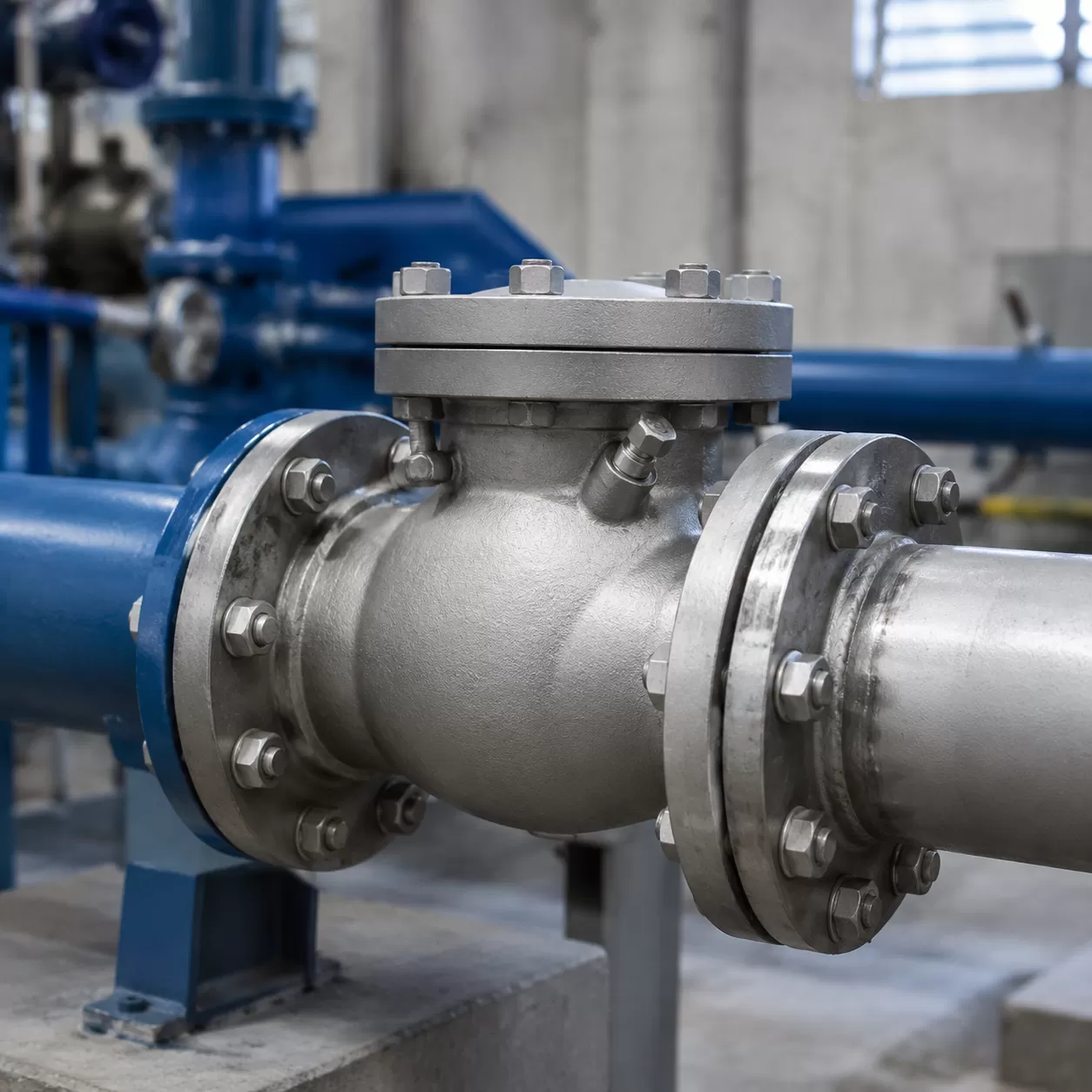
When we design a pump station check valve system, we cannot just look at the pipe size and call it a day. Proper sizing is the difference between a quiet, long-lasting setup and a system failure.
The Common Industry Mistake
Too many operators simply match the non slam check valve size to the existing pipeline diameter. If your line is 8 inches, they buy an 8-inch valve. This line-size matching is a major mistake that leads to premature equipment failure and poor pressure surge mitigation.
The Threat of Valve Flutter
When a valve is oversized for the actual flow rate, the fluid velocity isn’t strong enough to hold the disc fully open. The disc starts to bounce up and down in the flow stream. This valve disc flutter causes severe mechanical wear, damages the spring, and eventually prevents the valve from stopping a hydraulic shock wave.
- Symptoms of Flutter: Clicking noises, localized pipeline vibration, and premature spring failure.
- The Cause: Operation below the required cracking pressure and minimum flow velocity.
The Norite Engineering Protocol
At Norite, we use a strict calculation protocol based on your actual system dynamics rather than pipe size. We analyze the centrifugal pump discharge line data to ensure the valve stays fully open during normal operation.
| Sizing Step | Engineering Action | Target Metric |
|---|---|---|
| 1. Flow Velocity Analysis | Calculate minimum and maximum fluid velocity. | Ensure velocity exceeds minimum full-open requirements. |
| 2. Pressure Drop Check | Evaluate cracking pressure against pump curve. | Maintain system efficiency without restricting flow. |
| 3. Valve Sizing Selection | Size the valve body to the flow, using reducers if needed. | Eliminate valve disc flutter entirely. |
Valves Styles for Diverse Infrastructure
Different US infrastructure layouts require specific designs to achieve total reverse flow prevention without slamming.
- Spring Assisted Check Valve: Ideal for compact spaces and vertical lines where fast closure is critical.
- Axial Flow Silent Check Valve: Offers the lowest pressure drop and a straight-through flow path to minimize turbulence.
- Nozzle Check Valve: Built for massive municipal systems with high-velocity flows requiring ultra-fast, stroke-shortened response times.
System-Wide Best Practices for Eliminating Pump Station Transients
While installing a high-quality non-slam check valve is a critical line of defense, achieving complete pressure surge mitigation requires a holistic look at your entire piping network. A single component cannot fix systemic hydraulic issues. To fully protect your infrastructure from a catastrophic pumping system transient, you must implement a multi-layered strategy across the entire pump station.
Integrating Advanced Motor Controls
Relying on across-the-line pump starts and stops guarantees rapid fluid velocity deceleration, triggering severe hydraulic shock waves. Modern US municipal and industrial facilities must utilize advanced motor controls to smooth out these transitions.
- Variable Frequency Drives (VFDs): Program VFDs to slowly ramp pump speeds up or down, eliminating sudden pressure spikes during routine operations.
- Soft Starters: If VFDs are outside the budget, soft starters provide a controlled acceleration and deceleration ramp to prevent sudden fluid shifts.
Proper Pipeline Air Management
Air pockets inside a centrifugal pump discharge line magnify the destructive force of a pumping system transient. When moving water rapidly compresses trapped air, the resulting pressure spike can rupture pipes and crack valve bodies.
- Air Release Valves: Install these at high points along the pipeline to continuously exhaust small pockets of accumulated air during normal operation.
- Air/Vacuum Valves: Place these large-orifice valves downstream of the pump to admit air during a pump shutdown, preventing vacuum pockets that cause pipeline collapse, while safely exhausting air upon pump restart.
Operational Sequence Control
Hardware solutions are only as good as the logic controlling them. Synchronizing the timing between pump motors and control valves eliminates the gaps where severe pipeline vibration and water hammer thrive.
| Control Strategy | Action Timing | Primary Benefit |
|---|---|---|
| Pump Start Sequence | Start pump against a closed or slowly opening discharge valve. | Limits the initial flow velocity surge into an empty line. |
| Pump Stop Sequence | Program the motorized isolation valve to close to 90% before power off. | Minimizes the volume of water subject to sudden flow reversal closure. |
| Emergency Power Off | Rely on fast-acting, spring assisted check valves to close instantly. | Mechanical backup prevents backflow when electrical controls fail. |
Frequently Asked Questions about Non-Slam Check Valves
What is the difference between a silent check valve and a non-slam check valve?
A silent check valve is actually a specific type of non-slam check valve. While all silent valves are designed to prevent hydraulic shock, “non-slam” is a broader category that includes any spring assisted check valve, nozzle check valve, or axial flow silent check valve.
The main difference lies in the mechanism:
- Silent Check Valves: Utilize a center-guided stem and a heavy-duty internal spring to force the valve closed the exact millisecond fluid velocity reaches zero, completely avoiding flow reversal closure noise.
- Standard Non-Slam Valves: Can include dual-plate designs that reduce the travel distance of the disc, limiting slam but potentially allowing a tiny fraction of reverse flow compared to a true axial silent design.
Can you use a swing check valve in a vertical pipe run?
Technically yes, but it is highly discouraged for a centrifugal pump discharge line. In a vertical pipeline, gravity works against a traditional swing check valve.
When the pump shuts down, the fluid column reverses rapidly. A swing check valve has to travel a wide 90-degree arc to close. Because gravity accelerates the water backward before the disc can snap shut, vertical installations suffer from severe reverse flow prevention failure. This results in severe pipeline vibration, violent water hammer, and eventual equipment fatigue. For vertical runs, a non-slam check valve is the industry standard for industrial piping safety.
How do I know if my check valve is sizing correctly to prevent flutter?
You can identify proper sizing by evaluating the minimum media velocity against the valve’s cracking pressure and full-open requirements.
The Golden Rule of Valve Sizing: Never size a check valve based solely on the pipe size. Always size it based on the actual flow conditions of the pump station.
Signs your valve is sized incorrectly and experiencing valve disc flutter:
- Chattering Noise: Constant mechanical clicking at normal operating flow rates.
- Premature Wear: Rapid degradation of the internal pin, springs, and bushings.
- Incomplete Opening: If the system flow rate cannot produce enough dynamic pressure to hold the disc fully open against the spring, the disc will bounce in the flow stream, creating a massive pumping system transient.
To fix this, utilize the Norite engineering protocol to select a valve diameter that ensures the disc remains fully stable and wide open during standard operational flow. For project budgeting, specification review, or valve selection, you can also refer to the industrial valve price guide or contact Norite for engineering support.