

You might already know that selecting the wrong valve body can trigger catastrophic leaks, rapid seat deformation, or an unexpected plant shutdown.
But do you know exactly when to deploy a wafer design over a lug or flanged configuration?
Getting this choice right isn’t just about matching pipe sizes—it’s about ensuring pipeline integrity under intense fluid pressure. The wrong end connection can leave your maintenance team completely paralyzed when a downstream line needs isolated servicing.
At Norite, we see project managers struggle with this engineering trade-off every day: balancing low upfront material costs against long-term operational safety.
In this complete technical breakdown, we are going deep into the mechanical architecture of flanged vs wafer vs lug butterfly valves. You will learn precisely how these connections handle dead-end service, absorb pipeline vibration, and impact your total cost of ownership.
Let’s dive right in.
Flanged vs Wafer vs Lug Butterfly Valve: Which Connection Type Should You Choose?
When building or maintaining an industrial fluid control system, choosing the right valve connection is just as critical as the valve itself. The three primary options—wafer, lug, and flanged butterfly valves—each handle pipeline stress, pressure, and maintenance in entirely different ways. Selecting the wrong type can lead to costly leaks, system downtime, or premature component failure.
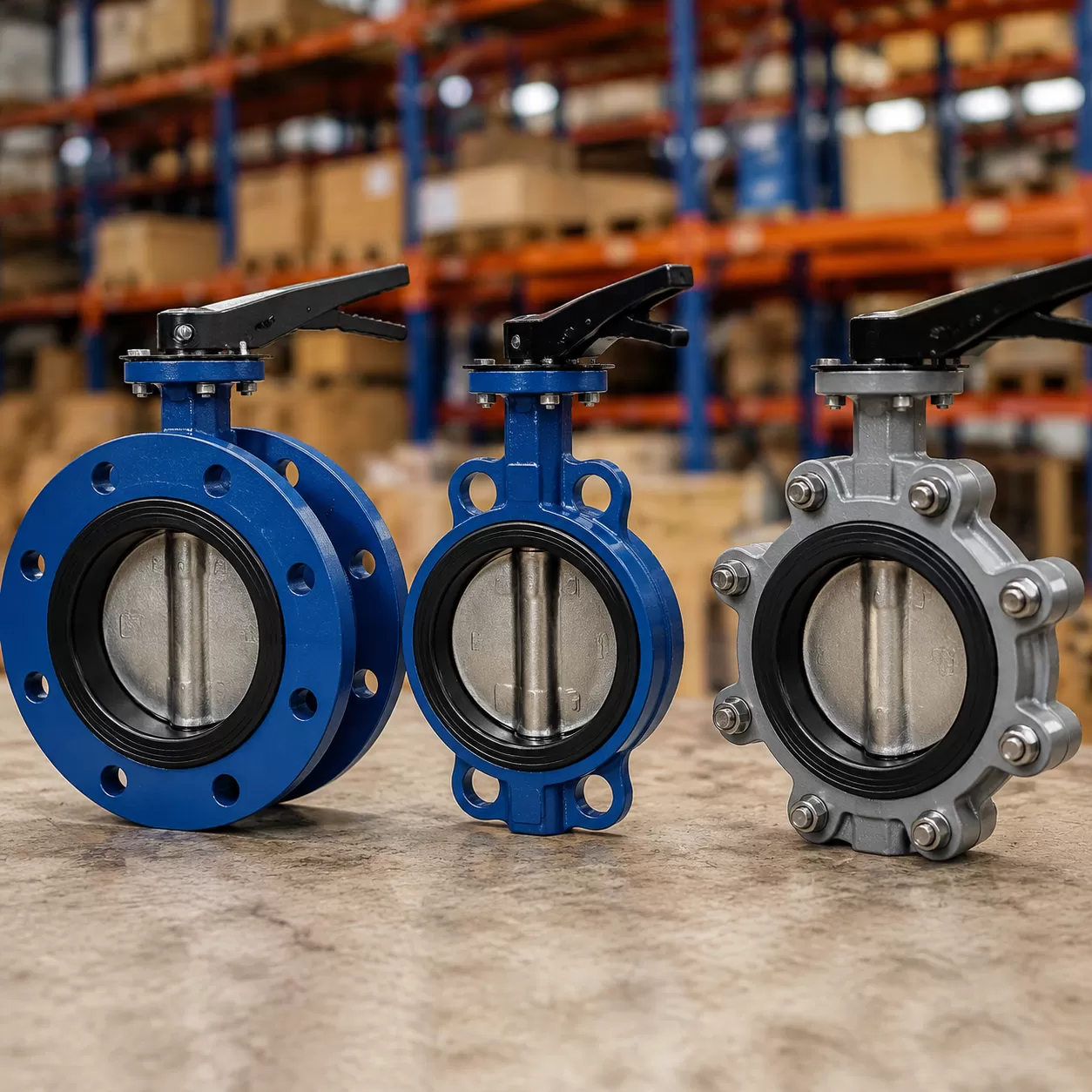
The core difference lies in how they connect to the pipe flanges:
- Wafer butterfly valves are sandwiched between two pipe flanges using long bolts that span the entire length of the valve body.
- Lug butterfly valves feature threaded lugs around the body, allowing them to bolt directly to each individual flange.
- Flanged butterfly valves utilize an integrated double-flanged design that matches the piping system bolt-for-bolt, typical in heavy-duty setups.
Wafer Butterfly Valve: The Compact Choice
Structural Architecture of Wafer Valves
The wafer butterfly valve utilizes a minimalist “sandwich” design. It does not bolt directly to the pipeline. Instead, we place it between two standard pipe flanges, and long external studs clamp the entire assembly together. The valve body features non-threaded alignment holes to help center the unit during installation.
Key Engineering Advantages
- Minimal Footprint: Features the shortest face-to-face dimensions of any valve style, making it ideal for tight spaces.
- Lightweight Design: Requires less material, lowering the physical load on your piping infrastructure.
- Unmatched Cost Efficiency: The lowest initial capital cost among the three connection types, providing an economical choice for bulk installations.
Critical Limitations
- No Dead-End Service: You cannot remove downstream piping while keeping the system pressurized. Opening the downstream side releases the clamping force, causing the valve to fail.
- Maintenance Headaches: Servicing a wafer valve requires completely draining and shutting down the entire line, which halts operations.
Best Applications
We recommend wafer-style configurations for systems with stable, low-pressure environments where budget and space are tight. For compact water and utility lines, Norite’s D71X Wafer Butterfly Valve is a practical option when fast installation, low pressure drop, and space-saving design are priorities.
- Commercial HVAC systems
- Building water supply lines
- Low-pressure industrial fluid control loops
- Light chemical and water treatment processes
Why Choose a Lug-Style Valve for Pipeline Isolation?
When you need to shut down a portion of your system without draining the entire line, a lug butterfly valve is the go-to choice for reliable pipeline isolation. Unlike wafer types, a lug-style valve allows for downstream piping maintenance because it anchors directly to the pipe flanges. This setup gives you the freedom to disconnect piping from one side of the valve while the other side remains fully operational under pressure.
Deep Dive 2: Lug-Style Butterfly Valves (The Maintenance Workhorse)
Structural Architecture: Machined, Threaded Lugs
The defining feature of a lug butterfly valve is its casing. The valve body features protruding, machined threaded lugs that align perfectly with the bolt circle of your pipe flanges.
- Dual-Side Bolting: Instead of long studs passing through the entire valve, the lug style uses two separate sets of flange bolts and studs that screw into opposite sides of the lugs.
- Secured Fit: This independent connection ensures the valve stays securely bolted to one pipe flange even if the adjacent pipe is completely removed.
Key Engineering Advantages: Independent Bolting and Dead-End Service
- Dead-End Service Capability: Because the valve body is bolted independently to each flange, it can safely handle full operating pressure rating forces as an end-of-line block valve.
- Easier System Maintenance: Technicians can clean, repair, or replace downstream equipment without shutting down the entire plant, saving significant operational downtime.
- Reduced Stress: The bolted lug structure handles system bending stress and vibration much better than a standard wafer setup.
Limitations: High Material Cost and Weight
- Higher Upfront Cost: Machining internal threads into multiple lugs requires more labor and metal, raising the total cost of ownership (TCO) compared to wafer options.
- Increased Weight: The extra metal on the valve body adds weight to the pipeline, requiring stronger pipe supports or hangers in large-diameter systems.
Best Applications: Pump Loops and Process Lines
Lug-style valves dominate heavy-use industrial fluid control applications across the United States where safety and uptime are critical. For a broader understanding of how butterfly valves are selected in water and wastewater projects, you can also review Norite’s guide to butterfly valves for water treatment.
- Pump Loops: Ideal for isolating pumps during routine seal or impeller replacements.
- Safety-Critical Process Lines: Used in chemical and water lines where unexpected line drops cannot be tolerated.
- Industrial Fluid Control: Pairs excellently with resilient valve seating materials (EPDM/NBR) to guarantee a bubble-tight shutoff during maintenance cycles.
When Do Large-Diameter Pipelines Require Flanged Connections?
When dealing with large-diameter pipelines, standard wafer or lug options often fall short. Massive piping systems subject to intense hydraulic forces require a rugged connection that can handle the stress. This is exactly where a flanged butterfly valve becomes a non-negotiable requirement for pipeline isolation and safety.
Deep Dive 3: Flanged Butterfly Valves (The Heavy-Duty Standard)
A double-flanged butterfly valve features a heavy-duty design specifically engineered for high-stress industrial fluid control. Unlike styles that get sandwiched between pipe flanges, this valve carries its own dedicated raised or flat flanges to bolt directly to the system.
Structural Architecture: Double-Flanged Body
The defining feature of a flanged butterfly valve is its integrated double-flanged body molded on both ends.
- Direct Bolting: The valve body contains its own bolt holes that match standard pipe flanges (like ASME B16.5 or B16.47).
- Robust Seating: It utilizes heavy-duty valve seating materials (EPDM/NBR) to guarantee a tight seal under massive structural loads.
- Short Face-to-Face Dimensions: Even with dual flanges, the design remains relatively compact compared to traditional gate or ball valves, saving critical pipeline space.
Key Engineering Advantages
- Maximum Structural Stability: The independent bolt circles distribute mechanical loads evenly, preventing pipe misalignment.
- High-Pressure Competency: Offers a superior operating pressure rating, making it highly reliable under severe hydraulic surges.
- Superior Resistance to Bending Stress and Vibration: The rigid, dual-flange connection safely absorbs heavy line vibration and prevents fugitive emissions.
Critical Limitations
- Largest Physical Footprint: The double-flange design naturally takes up more physical space and requires longer flange bolts and studs.
- Highest Initial Investment: The extra material and manufacturing precision mean a higher upfront price tag, impacting the initial total cost of ownership (TCO).
Best Applications
Flanged connections excel in heavy industrial environments across the United States where system failure is not an option. For large-diameter municipal and industrial pipelines, Norite’s D341X Flanged Butterfly Valve is designed for stable flange connection, reliable sealing, and low pressure loss in demanding flow control systems.
- Large-Diameter Pipelines: Municipal water transmission mains and large cooling water intakes.
- Water Treatment Plants: High-volume filtration systems and wastewater processing lines.
- Oil & Gas Infrastructure: Heavy-duty midstream transport and industrial fluid control processes.
Flanged vs Wafer vs Lug Butterfly Valve: Head-to-Head Comparison
Choosing the right butterfly valve connection comes down to how your piping system is built, how much maintenance it needs, and your budget. Instead of guessing, look at how the wafer butterfly valve, lug butterfly valve, and flanged butterfly valve stack up side-by-side on the factory floor.
The Decision Engine: Side-by-Side Comparison
| Comparison Factor | Wafer Butterfly Valve | Lug Butterfly Valve | Flanged Butterfly Valve |
|---|---|---|---|
| Installation Method | Sandwiched between pipe flanges using long through-bolts. | Bolted directly to threaded lugs using separate sets of bolts on each side. | Bolted directly to matching pipe flanges via integrated double-flange holes. |
| Bolt Patterns | No integrated bolt holes; relies on external flange bolts and studs. | Features matching bolt circles with threaded inserts. | Uses standard ANSI/ASME bolt patterns on a double-flanged butterfly valve body. |
| Dead-End Suitability | No. Cannot be used for pipeline isolation at the end of a line. | Yes. Allows for safe dead-end service and downstream maintenance. | Yes. Excellent for dead-end and high-surge end-of-line applications. |
| Downstream Piping Maintenance | Requires complete system shutdown and line drainage to remove. | Permits downstream piping maintenance while keeping the upstream side live. | Easy to isolate and remove without disturbing adjacent pipe sections. |
| Operating Pressure Rating | Best for low to medium pressures (typically up to Class 150). | Strong performance in medium to high pressures. | Maximum pressure competency for heavy-duty systems. |
| Bending Stress and Vibration | Vulnerable to high bending stress and vibration; prone to misalignment. | Absorbs localized stresses well due to independent bolting. | Superior structural stability; easily handles high mechanical forces. |
| Total Cost of Ownership (TCO) | Lowest initial cost; light weight reduces shipping and labor expenses. | Moderate capital cost; balances price with maintenance flexibility. | Highest initial investment; heavy footprint but offers maximum lifespan in large-diameter pipelines. |
Key Takeaways for Industrial Fluid Control
- Wafer connections save space and cut upfront costs but lock you into full system shutdowns for simple gasket swaps.
- Lug connections act as the ultimate maintenance workhorses, giving you the freedom to disconnect downstream piping without losing pressure upstream.
- Flanged connections provide the heavy-duty framing required for big infrastructure, offering the highest sealing security against fugitive emissions under extreme mechanical loads.
5 Rules for Choosing Your Butterfly Valve Connection
Selecting the right butterfly valve connection isn’t just about matching pipe sizes. It is about balancing system safety, maintenance costs, and long-term reliability. We use five core engineering rules to choose between a flanged vs wafer butterfly valve or a lug butterfly valve.
Rule 1: Evaluate the Pipe Diameter and Size Rules
Pipeline size heavily dictates your connection style. For smaller, standard lines, a wafer butterfly valve or lug butterfly valve is the go-to choice due to cost and weight efficiency. However, for large-diameter pipelines, a double-flanged butterfly valve is the industry standard. Large pipes handle massive volumes and require the heavy-duty structural support that only dedicated pipe flanges can provide.
Rule 2: Determine Downstream Piping Maintenance Needs
If your team needs to work on the piping system without shutting down the entire line, look closely at how the valve handles pipeline isolation.
- Wafer valves cannot handle dead-end service. Removing downstream piping causes the valve to fall out.
- Lug-style valves feature independent bolting with threaded lugs, allowing you to isolate the line and perform downstream piping maintenance safely under full pressure.
Rule 3: Factor in System Pressures and Mechanical Forces
High operating pressure ratings require robust valve bodies. Look at the mechanical stresses your system will endure:
- High-pressure, high-vibration systems put massive bending stress and vibration on connections.
- Flanged butterfly valve designs distribute these mechanical forces evenly across the flange bolts and studs, preventing leaks.
- For low-pressure, steady utility lines, wafer connections hold up perfectly fine.
For systems where seat wear, pressure stability, and long service life are major concerns, a double eccentric butterfly valve can provide a stronger sealing structure than a basic concentric design.
Rule 4: Review Space and Budget Tolerances
Every project has physical and financial limits. You must weigh the total cost of ownership (TCO) against your current budget and spatial footprint:
| Valve Connection Type | Face-to-Face Dimensions | Initial Capital Cost | Weight & Installation Effort |
|---|---|---|---|
| Wafer | Ultra-Compact | Lowest | Lightweight & Fast |
| Lug | Medium | Moderate | Moderate Weight |
| Flanged | Wide Footprint | Highest | Heavy & Labor-Intensive |
Rule 5: Media and Environmental Hazard Risks
The nature of the fluid inside your industrial fluid control system changes everything. If you are dealing with hazardous chemicals, high temperatures, or strict environmental regulations, your choice impacts fugitive emissions. Ensure your valve seating materials (EPDM/NBR) match the media, and choose a flanged or lug connection to guarantee a tight, permanent seal against the environment.
For wastewater projects that involve mixed media, pump stations, sludge lines, or large flow control points, this broader guide on wastewater valves used in treatment plants can help match the right valve type to each stage of the system.
Frequently Asked Questions
Can you use a wafer butterfly valve for dead-end service?
No, you should never use a standard wafer butterfly valve for dead-end service. Because a wafer valve is sandwiched between two pipe flanges using long flange bolts and studs, removing the downstream piping means there is nothing left to hold the valve in place. The line pressure would blow the valve right off the pipe. For safe pipeline isolation at the end of a line, always choose a lug butterfly valve or a double-flanged butterfly valve.
What is the main advantage of a double-flanged butterfly valve?
The biggest advantage of a flanged butterfly valve is maximum structural stability under extreme heavy-duty conditions. With a double-flanged body molded on both ends, this connection type handles high operating pressure rating limits and massive mechanical forces without breaking a sweat. It is the absolute standard for large-diameter pipelines in US water treatment and industrial fluid control where failure is not an option.
How does line vibration affect your choice of valve connection?
Heavy line vibration and bending stress will loosen standard wafer connections over time, increasing the risk of external leaks and fugitive emissions. If your system deals with heavy pump loops or fluid shock, you need a lug butterfly valve with integrated threaded lugs or a robust flanged butterfly valve. These connections bolt directly to the pipe flanges, absorbing system vibration and keeping your valve seating materials (EPDM/NBR) properly aligned.
If you are unsure which connection type fits your working pressure, pipe diameter, media, or maintenance plan, you can contact Norite for project-based valve selection support.






