
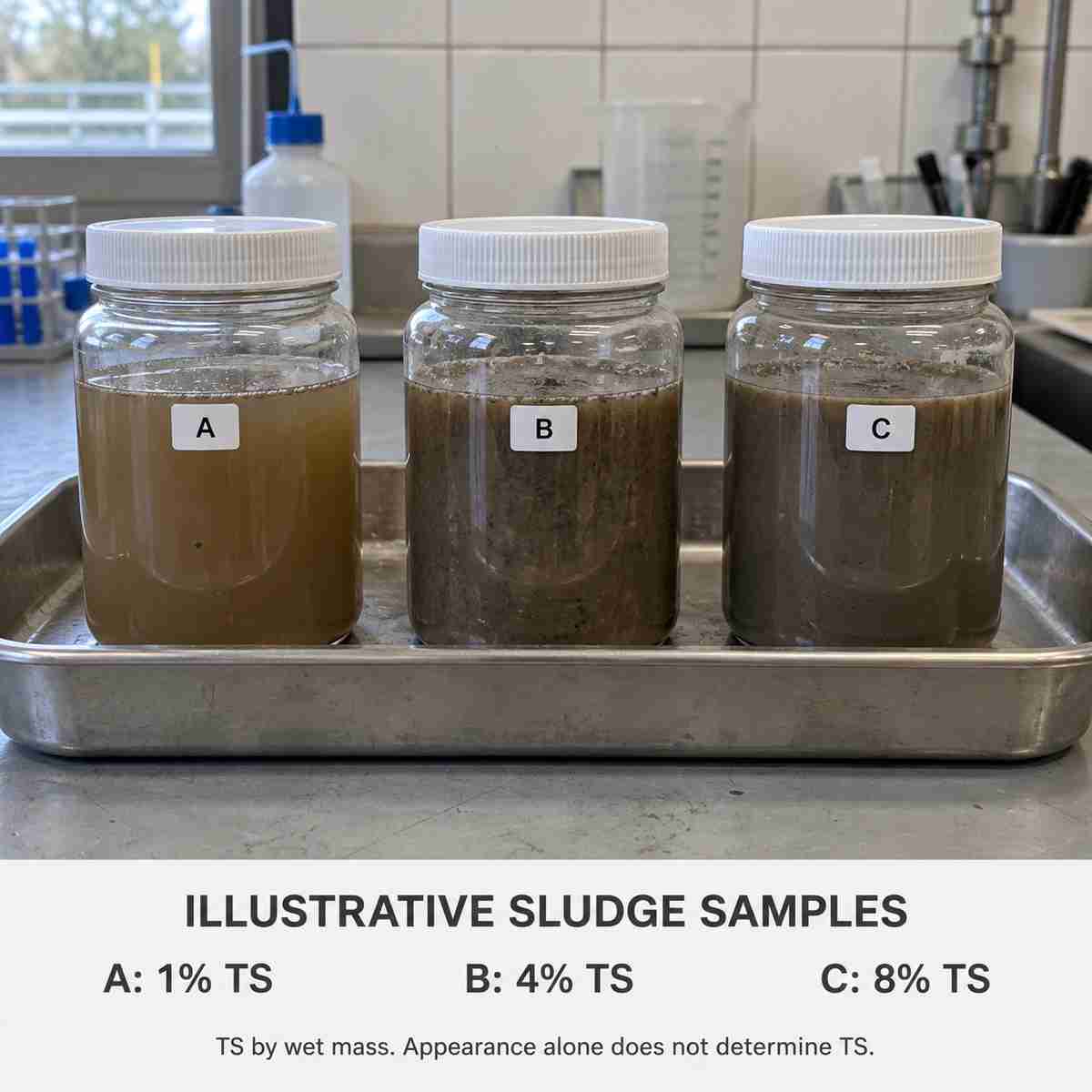
Sludge valve selection by solids content starts with the measured solids concentration, then checks what those solids contain and how the line operates. Screened, dilute sludge may suit an approved resilient seated gate valve. Fibrous or thickened sludge calls for a closer review of full-port knife gate, pinch, or eccentric plug designs. Abrasive grit, flow control duty, and high closing differential pressure can change that shortlist at any concentration.
Use the table below to organize an initial selection. The percentage bands are working categories for this guide, not industry-standard valve limits or guarantees of suitability.
Quick selection table: low, medium, and high solids
All percentages below mean total solids (TS) by mass in the wet sludge sample.
| Working category | TS by mass | Initial valve shortlist | What can change the selection? |
|---|---|---|---|
| Low-solids sludge | Below 2% | Wastewater-approved resilient seated gate valve for screened isolation duty; knife gate or eccentric plug valve where fibers remain | Rags, grit, intermittent flow, and seat deposits can still make a dilute stream difficult |
| Medium-solids sludge | 2% to below 6% | Full-port knife gate for isolation; appropriately configured pinch or eccentric plug valve where suitable | Abrasion, settling, polymer conditioning, and frequent cycling require closer review |
| High-solids, pumpable sludge | 6% and above | Slurry-duty knife gate, suitable pinch valve, or engineered eccentric plug configuration | Verify rheology, restart behavior, pressure, wear components, and cleaning access |
| Paste-like or dewatered material | Any concentration at which conventional liquid handling becomes unsuitable | Specialist pump-and-valve or bulk-material handling review | Pumpability and equipment arrangement take priority over this table |
A stream does not change behavior abruptly at 2% or 6%. Record its minimum, normal, and maximum TS and assess the most demanding credible condition. High-solids sludge also has no universal upper concentration limit for pumpability.
For the broader distinction between isolation and non-return duties, see our sludge valve selection guide.
Have a sludge analysis or an existing valve that keeps blocking? Send Norite your TS range, pipe size, pressure, and operating problem for an application review.
Confirm what the solids percentage measures
A specification that says “5% solids” is incomplete unless it identifies the measurement basis.
For TS by mass:
TS (%) = dry residue mass ÷ original wet sample mass × 100
For example, 5 g of dry residue from a 100 g wet sample represents 5% TS, using the specified laboratory drying method. It does not mean that 5% of the pipe volume consists of particles.
Keep these measurements separate:
- TS includes suspended and dissolved residue remaining after the specified test.
- Total suspended solids (TSS) measures the suspended fraction retained by the test filter, commonly reported in mg/L.
- Solids by volume is a different basis and requires density information for conversion to a mass fraction.
TSS alone does not describe the entire sludge mixture. Even a correct TS result says little about the size of a stone, the length of a wipe, or the abrasiveness of sand.
Request a representative sample from the valve location. A sample taken before a thickener or polymer dosing point may not represent the material passing through a downstream valve. Record temperature and sampling conditions alongside the result.
Choosing a low solids sludge valve: below 2% TS
For screened sludge with few fibers and little abrasive material, an application-approved resilient seated gate valve can be a reasonable isolation candidate. Check its internal passage and the manufacturer’s wastewater service limits.
The main question is what remains after screening. A 1% TS stream carrying long wipes can cause more blockage than a higher-concentration stream containing small, soft particles. A low percentage also does not make a sand-bearing stream non-abrasive.
Consider a knife gate or eccentric plug design when the operating history shows ragging, debris trapped at the seat, or difficult closure. Evaluate the actual opening and internal geometry rather than relying on the nominal connection size.
Butterfly valves deserve a separate check. The disc remains in the flow passage when open, so retained fibers and larger debris matter. They can be suitable for certain screened wastewater duties, but low TS alone is insufficient justification.
Before retaining an existing low solids sludge valve, inspect maintenance records: what blocked it, where the material collected, and whether the problem appeared after shutdown or during normal flow.
Choosing a medium-solids sludge valve: 2% to below 6% TS
Within this working band, compare the duty against three questions: does the material settle, does it contain grit, and must the valve regulate flow?
For isolation, a full-port knife gate valve is a candidate where the design accommodates the solids and required pressure. Examine the seat area, gate guidance, packing, and any flushing provisions. The term “knife gate” does not establish the valve’s abrasion resistance or its ability to cut every type of debris.

Pinch valves and eccentric plug valves provide other options. A pinch valve uses a flexible sleeve; its suitability depends on sleeve material, pressure, temperature, and cycling. An eccentric plug valve may suit isolation or control, but port area and the selected configuration require checking.
Continuous modulation needs its own review. An ordinary isolation knife gate should not be left partly open to regulate sludge flow unless its manufacturer explicitly approves that duty. Ask for control sizing across minimum and maximum flow, including the openings at which solids must pass.
For a detailed comparison of conventional gate and knife gate construction, read sludge gate valve vs knife gate valve.
Choosing a valve for thick sludge: 6% TS and above
For a valve for thick sludge, request more than the concentration figure. Ask how the material moves after resting, whether it adheres to surfaces, and how much the properties change with temperature or conditioning.
A single viscosity value can be misleading for non-Newtonian sludge. Where rheology affects sizing, provide apparent viscosity at stated temperature and shear conditions, or a measured flow curve. Include yield stress if available.
Compare the following candidates against the actual service:
| Candidate | Reason to evaluate it | Details to confirm |
|---|---|---|
| Slurry-duty knife gate | Open flow passage for isolation of solids-bearing material | Seat arrangement, wear protection, thrust requirement, and containment during operation |
| Pinch valve | Flexible wetted sleeve and suitable configurations for isolation or control | Chemical compatibility, abrasion, pressure and vacuum limits, and sleeve replacement access |
| Engineered eccentric plug valve | Potential for isolation or control of viscous sludge | Port area, surface treatment or lining, torque, orientation, and deposit management |
| Specialist through-going or hopper arrangement | Potential fit for particular dense-material transfer systems | Compatibility with the conveying equipment and required pressure containment |
Some push-through slurry knife gates release a small amount of process material during cycling by design. Establish whether the installation permits this and how discharge will be collected. Indoor or odor-sensitive service may require a different arrangement.
Restart conditions can be more demanding than steady operation. Tell the supplier whether the line rests for hours, days, or a season, and whether the valve must close through stationary material. Plan cleaning before deposits become compacted.
Review the available Norite knife gate valve with the application data. Ask for confirmation of the proposed model’s limits; a product family name does not qualify every configuration for thick sludge.
Five checks that can override the solids-content shortlist
1. Fibers and abrasive particles
List fibers, wipes, sand, grit, and hard particles separately. Provide maximum particle dimensions and representative photographs where possible. Knife gates do not replace upstream screening or maceration equipment.
For abrasive service, ask which surfaces receive wear protection and which parts can be replaced. Increasing stainless steel grade alone does not establish abrasion resistance.
2. Isolation, control, or backflow prevention
Specify the valve’s function before requesting a quotation. A wastewater sludge valve used for isolation has different requirements from one that modulates flow all day. Backflow prevention requires a separately selected non-return arrangement; a check valve alone is not a maintenance isolation barrier.
3. Pressure at the moment of closure
Provide line pressure and maximum differential pressure across the valve during opening and closing. Include credible transients and any reverse pressure.
A flange marked PN16 does not by itself confirm the assembly’s allowable pressure at temperature, its reverse sealing capability, or the actuator’s ability to close through deposited sludge. Our PN10, PN16, and PN25 selection guide explains the pressure-rating checks.
4. Chemical exposure and temperature
List the actual sludge chemistry, oil or grease content, treatment additives, and cleaning chemicals. Check every wetted material, including seats, sleeves, packing, and coatings. A material suitable for normal operation may have different limits during cleaning.
5. Installation and maintenance access
Confirm orientation, actuator clearance, pipe support, and the space needed to remove wear parts. Follow the selected manufacturer’s installation instructions.
Where the pipe arrangement needs axial removal clearance, a suitable dismantling joint may help. Its restraint and support requirements must be included in the piping design.
Three worked selection examples
These are hypothetical screening examples, not Norite project references or final equipment specifications.
| Example conditions | Initial selection direction | Approval still needed |
|---|---|---|
| DN150, 1% TS, screened biological sludge, little grit, on/off duty | Compare a wastewater-approved resilient seated gate with a full-port knife gate | Remaining fiber load, operating pressure, closure differential, and seat performance |
| DN100, 4% TS, primary sludge with sand, intermittent transfer | Compare abrasion-configured knife gate and suitable pinch designs | Particle characteristics, deposit behavior, wear-part life, and shutdown cleaning |
| DN80, 8% TS, polymer-conditioned sludge, frequent flow adjustment | Review a control-rated pinch or engineered eccentric plug arrangement | Rheology, full flow range, available differential pressure, minimum operating opening, and actuator sizing |

The 1% example changes if screening allows long wipes through. The 4% example changes if hard grit dominates the solids. The 8% example may need a different arrangement if the material cannot restart reliably after a shutdown.
This is why a slurry valve quotation should state the assumed medium and duty alongside the selected model.
What to include in a wastewater sludge valve RFQ
Use the following checklist to make supplier quotations comparable.
| RFQ field | Information to provide |
|---|---|
| Process stream | Primary, return activated, waste activated, digested, thickened, or industrial sludge; exact valve location |
| Solids data | Minimum/normal/maximum TS, mass or volume basis, sampling point, and test method |
| Debris and abrasion | Particle size, grit, sand, fibers, wipes, and screening arrangement |
| Flow behavior | Temperature, density, settling, available rheology, and longest shutdown period |
| Duty | Isolation, modulation, or backflow prevention; cycles per day and required failure position |
| Hydraulic conditions | Minimum/normal/maximum flow and pressure; opening/closing differential; reverse pressure, vacuum, and transients |
| Connections | DN/NPS, actual pipe bore, flange standard and rating, and face-to-face limits |
| Materials | Chemistry, cleaning fluids, and any project material requirements |
| Actuation | Manual, pneumatic, electric, or hydraulic; available utilities and control signals |
| Acceptance | Required leakage limit, test standard, test direction, and documentation |
| Commercial scope | Quantity, destination, delivery requirements, and requested spare parts |
Ask the supplier to return a model-specific datasheet, dimensional drawing, material schedule, actuator sizing basis, and stated exclusions. Define shell and seat testing separately; our valve hydrostatic testing guide explains that distinction. A successful clean-water seat test does not demonstrate service life in abrasive sludge.
Frequently asked questions
What solids percentage requires a knife gate valve?
There is no universal percentage. The bands in this guide organize an initial review. Fibers, grit, deposits, pressure, and operating function determine whether a particular knife gate is suitable.
Is a pinch valve always the best valve for thick sludge?
No. A pinch valve can be a candidate, but sleeve compatibility, pressure, vacuum, temperature, and replacement access must fit the service. Compare it with other suitable configurations using the same duty data.
Can I use TSS in mg/L instead of TS percentage?
Provide the measured result with its units and method. TSS and TS measure different fractions. Do not substitute one for the other without understanding the dissolved fraction and, where conversion requires it, the sludge density.
Is a slurry valve different from a sludge valve?
Both terms describe service rather than a single mechanism. Mineral slurry may present different abrasion and density conditions from biological sludge. Specify the actual medium and valve function.
What if the plant cannot provide viscosity data?
Start with the TS range, process description, temperature, pumping history, and shutdown behavior. Tell the supplier that rheology is unknown. For difficult transfer or control duties, representative testing may be needed before final sizing.
Request a valve review for your sludge line
Contact Norite with your sludge valve requirements. Send the following details, plus an existing valve photo or drawing if available:
Process and valve location:
TS range and measurement basis:
Grit, particle size, and fibers:
Pipe size and connection standard:
Flow, pressure, and maximum closing differential:
Isolation or flow-control duty:
Temperature and longest shutdown:
Existing failure or maintenance problem:
Actuator preference, quantity, and destination:
Ask for the proposed configuration, confirmed operating limits, and spare-parts scope to be stated in the quotation before placing the order.






