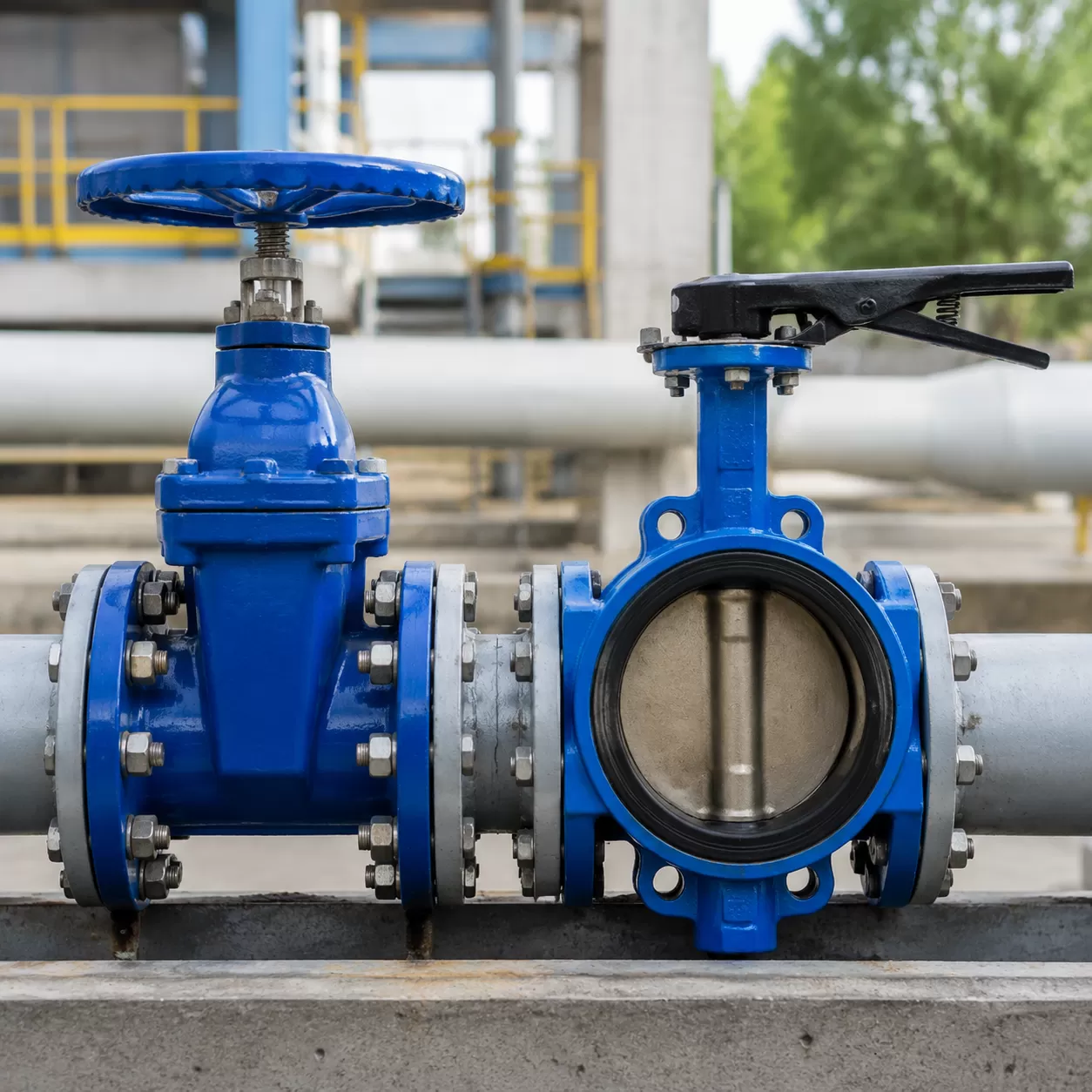
When comparing gate valve vs butterfly valve options for water supply pipelines, engineers need to look beyond basic product preference and evaluate flow efficiency, maintenance costs, installation space, and long-term operational safety.
Get it right, and your pipeline runs smoothly with minimal pressure drops. Get it wrong, and you face premature seat wear, catastrophic water hammer, or budget-destroying pumping energy losses.
As a pipeline engineer or water utility manager, you cannot rely on generic product catalogs. You need hard, data-driven criteria to justify your procurement. Should you opt for the unobstructed flow path of a resilient seated gate valve, or does the compact, cost-effective footprint of a triple offset butterfly valve make more sense for your large-diameter mains?
This engineering-backed guide strips away the marketing fluff to compare these two pipeline isolation powerhouses head-to-head. Let’s dive straight into the technical breakdown.
Understanding the Core Mechanics of Water Valves
Selecting the right pipeline isolation valve requires a deep understanding of internal mechanical movements. Both gate valves and butterfly valves serve as pillars in municipal water distribution networks, yet their structural approaches to fluid control are entirely distinct.
Gate Valves Explored: Linear Wedge Design
A gate valve operates via a linear motion mechanism. When the valve is opened, a vertical wedge or disc moves entirely out of the fluid path.
- Unobstructed Flow: The defining benefit of a gate valve is its clear, full-bore waterway. When fully open, the media flows through the valve body in a straight line with virtually no resistance.
- Rising Stem vs. Non-Rising Stem (NRS): In water supply infrastructure, choosing between stem designs is critical. Rising stems move upward as the valve opens, providing an immediate visual indicator of the valve’s position, making them ideal for treatment plants and exposed piping. Conversely, non-rising stem (NRS) gate valves keep the stem inside the body during operation. NRS designs are the industry standard for direct buried gate valve applications and tight valve vaults because they conserve vertical space.
Butterfly Valves Explored: Quarter-Turn Disc Design
A butterfly valve relies on a rotary, quarter-turn vs linear valve operation. Isolation is achieved by rotating a circular disc 90 degrees within the pipe bore.
- Quarter-Turn Efficiency: The disc rotates on a central or offset axis. When open, the disc sits parallel to the flow; when closed, it seals against a resilient seat in the valve body.
- Concentric vs. Eccentric Designs: Standard water mains utilize different disc offsets based on pressure needs. Concentric (lined) designs feature a centered stem and are common in low-pressure utility lines. For high-performance water isolation, eccentric designs—such as double or triple offset butterfly valve configurations—lift the disc off the seal during rotation. This reduces friction, prevents seat wear, and ensures a tighter, zero leakage shut-off over a longer service life.
Flow Efficiency and Pressure Drop Head Loss
When comparing a gate valve vs butterfly valve for water supply pipelines, flow efficiency is a massive factor in long-term operational costs. Gate valves excel in municipal water distribution networks because their vertical wedge retracts completely out of the flow path. When fully open, a resilient seated gate valve leaves the pipeline entirely unobstructed. This design delivers a near-zero valve pressure drop coefficient, meaning the water experiences virtually no resistance, and head loss is kept to an absolute minimum.
In contrast, a butterfly valve features a closing disc that stays permanently positioned right in the center of the water stream, even when fully open. This constant obstruction creates turbulence and a permanent restriction, inherently increasing the flow control valve head loss. Over miles of large-diameter water mains, this continuous drop in pressure forces pumping stations to work harder to maintain system pressure. Over a 20-year span, the extra pumping energy costs caused by butterfly discs can add up to thousands of dollars per valve, making gate valves the superior choice for maximizing hydraulic efficiency in high-flow lines. Implementing smart pipeline valves with IoT predictive maintenance can help engineers monitor these pressure drops in real time to optimize long-term energy use across the network.
Pipe Diameter and Structural Weight Limitations
When designing a municipal water distribution network, pipe diameter dictates your valve selection. There is a clear transition point in water supply pipelines: systems under 12 inches (DN300) are dominated by the gate valve, while large-diameter water mains favor the butterfly valve.
┌────────────────────────────────────────────────────────┐
│ VALVE SELECTION BY DIAMETER │
├───────────────────────────┬────────────────────────────┤
│ Under 12″ (DN300) │ 12″ (DN300) and Larger │
│ ► Choose Gate Valves │ ► Choose Butterfly Valves │
│ ► Robust, full-bore │ ► Lightweight, compact │
└───────────────────────────┴────────────────────────────┘
Why Gate Valves Dominate Systems Under 12 Inches (DN300)
For smaller distribution lines, a resilient seated gate valve is the industry standard. At these sizes, the weight and physical footprint of a gate valve are perfectly manageable for standard installation crews. They provide a robust, full-bore isolation point that handles typical neighborhood distribution pressures without breaking a sweat. The structural integrity of a smaller gate valve handles high torque and rough trench conditions easily.
Why Large-Scale Mains Favor Lightweight Butterfly Valves
As pipelines scale up past the 12-inch mark, the physics shift drastically. A 24-inch gate valve is an absolute beast—heavy, incredibly tall, and expensive to manufacture, transport, and install. It requires massive concrete support thrust blocks just to hold it in place.
On the other hand, a quarter-turn vs linear valve comparison reveals why butterfly valves win in large-scale transmission lines:
- Weight Reduction: Butterfly valves can be up to 70% lighter than a gate valve of the same nominal size.
- Compact Structural Footprint: The narrow face-to-face dimension requires significantly less space in the trench or valve vault.
- Lower Structural Load: They place far less stress on the pipeline infrastructure, reducing the need for costly heavy-duty pipe supports.
For major water transmission headers, choosing a lightweight, compact butterfly valve keeps structural loads low and installation costs practical.
Installation Footprint and Space Optimization
When you are designing underground valve vaults or compact pump stations, physical space is money. The face-to-face dimensions of your pipeline isolation valve dictate the entire footprint of the chamber, directly impacting your excavation and structural concrete costs.
Face-to-Face Dimension Comparison
Butterfly valves are much thinner than gate valves. A standard butterfly valve features a compact, wafer or lug-style body that slips easily between flanges.
- Butterfly Valves: Require minimal linear pipe real estate, making them the ultimate space-savers in tight municipal water distribution networks.
- Gate Valves: Feature wide, bulky bodies that demand a significantly larger longitudinal footprint along the water supply pipeline.
Handling Vertical Clearance Constraints in Valve Chambers and Pits
The challenge is not just horizontal room; vertical clearance in shallow utility trenches is a major hurdle for United States water works engineers.
- The Gate Valve Problem: Rising stem designs require massive overhead clearance just to open fully. Even non-rising stem (NRS) gate valves feature tall bonnets to house the retracted wedge, requiring deep, expensive concrete vaults.
- The Butterfly Valve Advantage: These units utilize a simple quarter-turn mechanism. Because the disc rotates internally within the pipe axis, the actuator sits tightly against the pipe body.
If you are dealing with tight overhead limits or high groundwater tables where deep pits are impractical, a compact butterfly valve keeps your vault depths manageable. For systems where space constraints are severe, integrating specialized air valves for municipal pipelines alongside low-profile isolation valves helps maintain system integrity without expanding your chamber footprint.
Sealing Performance and Leakage Prevention
Achieving a zero leakage shut-off is the top priority for any municipal water distribution network. The choice between a gate valve vs butterfly valve often comes down to how each handle long-term sealing performance and pipeline debris.
Resilient vs. Metal Seating
Modern water systems heavily rely on resilient seating to ensure a drop-tight seal.
- Resilient Seated Gate Valves: These utilize a wedge fully encapsulated in high-grade elastomer (EPDM or NBR). When closed, the wedge compresses evenly against the smooth interior of the valve body, swallowing small pipeline debris without damaging the seal.
- Butterfly Valves: These feature a rubber seal either on the disc or the body. While standard configurations offer excellent tight shut-off, high-pressure or heavy-duty transmission lines often upgrade to a triple eccentric butterfly valve design. This triple-offset geometry allows the disc to seal with minimal friction, drastically reducing seat wear.
Impact of Sediment and Grit Accumulation
Over time, water mains carry sediment, pebbles, and tuberculation rust. How each pipeline isolation valve manages this debris determines its lifecycle.
- Gate Valve Tracks: Older metal-seated gate valves have a recessed groove at the bottom to catch the wedge. Sediment easily collects in this trench, preventing the gate from dropping fully and causing persistent leaks. Modern resilient seated gate valves fix this with a smooth, pocketless bottom, but grit can still scrape the vertical tracks over decades of use.
- Butterfly Disc Seats: Because the disc sits directly in the flow path, the sealing edge is continuously exposed to high-velocity grit when opening or closing. If a stone or hard scale gets trapped between the disc and the resilient seat during closure, it can score the rubber, compromising the tight seal and requiring a full seat replacement.
Actuation and Operation Speed: Gate Valve vs Butterfly Valve
When managing a municipal water distribution network, the speed at which you can open or close a pipeline isolation valve drastically changes how you handle emergencies and routine maintenance. The core difference comes down to a multi-turn linear mechanism versus a quick, 90-degree quarter-turn operation.
Multi-Turn Manual Operations vs. Quarter-Turn Actuation
Gate valves require multiple full turns of the handwheel or operating nut to raise or lower the internal wedge. For large-diameter water mains, this manual operation can take several minutes and significant physical effort.
Conversely, a butterfly valve utilizes a quarter-turn vs linear valve design, requiring only a simple 90-degree rotation to go from fully open to fully closed. This makes butterfly valves incredibly fast to operate, making them the preferred choice when rapid isolation is needed in treatment plants or pump stations.
Managing Fluid Hammering Risk in Water Pipelines
While the quick operation of a butterfly valve sounds ideal, it introduces a major hydraulic hazard: fluid hammering. Shutting down a high-velocity water line too quickly creates sudden pressure surges that can rupture pipes, loosen joints, and destroy expensive equipment.
- Gate Valves: The slow, multi-turn closure naturally provides fluid hammering prevention by gradually slowing down the water column.
- Butterfly Valves: Because they can close instantly, manual butterfly valves on transmission lines often require gear operators to slow down the stroke. If automated, electric or pneumatic actuators must be calibrated with specific stroke times to avoid dangerous pressure spikes.
For operators looking to protect their broader system infrastructure beyond just the valves, integrating reliable filtration like a Y-type filter upstream helps ensure that fast-moving debris doesn’t compromise seat integrity during sudden closures. Balancing operation speed with surge control is a critical step in smart water supply valve selection.
Technical Comparison Matrix for Pipeline Selection
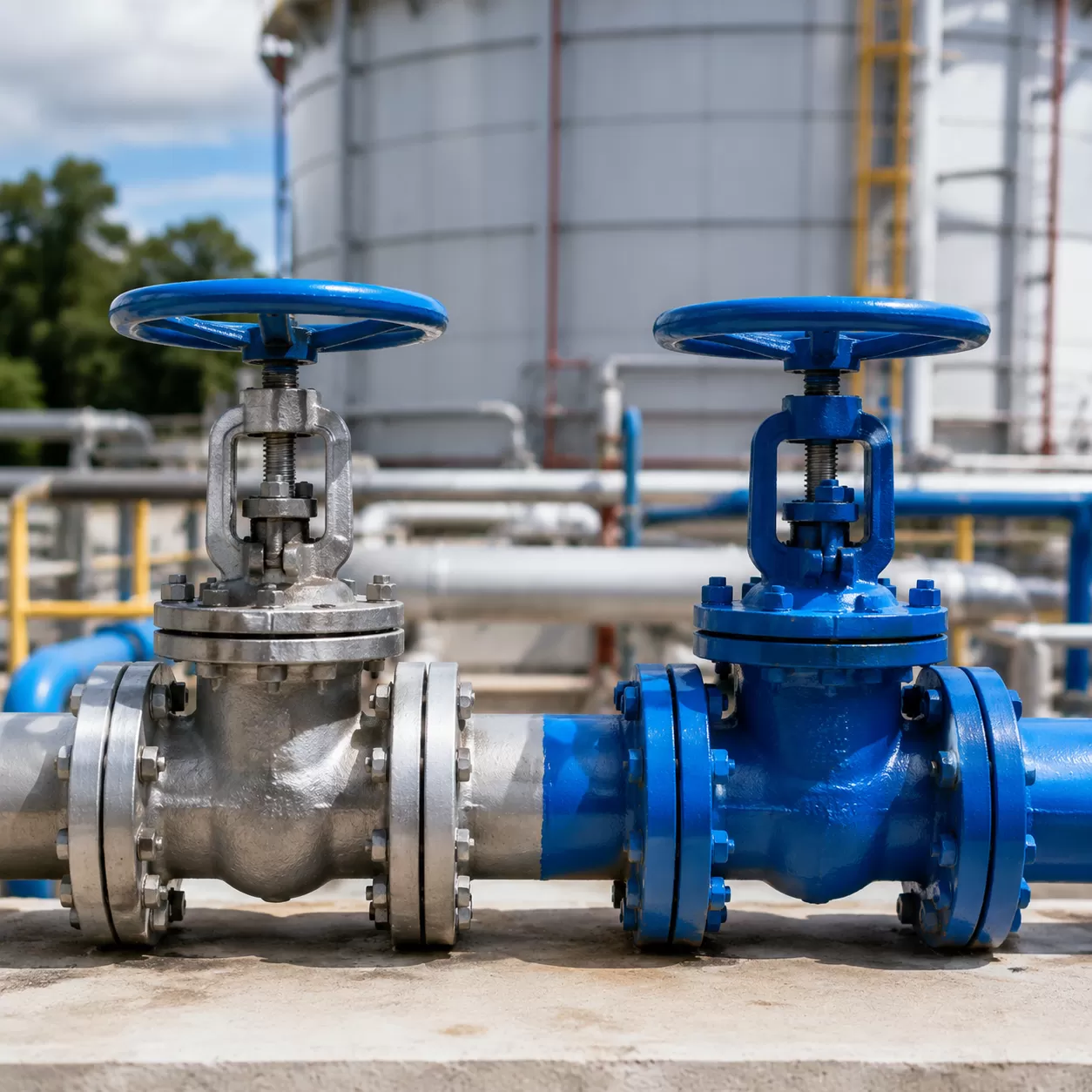
When designing a municipal water distribution network, selecting the right pipeline isolation valve comes down to balancing structural limits, flow efficiency, and installation footprints. To help streamline your water supply valve selection, we have compiled a side-by-side comparison matrix breaking down the core technical differences between a gate valve vs butterfly valve.
| Technical Parameter | Gate Valve | Butterfly Valve |
|---|---|---|
| Operation Type | Multi-turn linear movement (slower actuation) | Quarter-turn $90^circ$ rotation (quick actuation) |
| Flow Resistance & Head Loss | Near-zero; completely unobstructed flow path | Higher; disc sits permanently in the flow stream |
| Valve Pressure Drop Coefficient ($C_v$) | Exceptionally high (minimal pumping energy costs) | Moderate (higher permanent pressure drop) |
| Ideal Diameter Range | Best for small to medium lines under 12 inches (DN300) | Dominated by large-diameter water mains over 12 inches |
| Face-to-Face Dimensions | Wide; requires substantial horizontal pipeline space | Compact and wafer-thin; highly space-efficient |
| Weight & Structural Load | Heavy cast iron/ductile iron body; requires support | Lightweight; reduces the need for heavy pipe hangers |
| Sealing Mechanism | Resilient seated gate valve wedge or metal-to-metal | Concentric or triple offset butterfly valve seats |
| Debris & Grit Tolerance | Susceptible to sediment build-up in the bottom track | Self-cleaning disc design; minimal sediment traps |
Selecting the wrong valve profile can drastically impact long-term system efficiency. For instance, pairing an oversized gate valve with high-velocity flows can complicate manual operations, while a poorly placed butterfly valve can trigger a high valve pressure drop coefficient that drives up utility pumping costs over time. Ensuring proper alignment between your system’s hydraulic requirements and your valve material selection ensures zero-leakage shut-off and prevents premature component failure.
Critical Selection Criteria for Water Engineers
When designing a municipal water distribution network, choosing between a gate valve vs butterfly valve comes down to your specific pipeline environment and operational goals. Both serve as vital pipeline isolation valve options, but their real-world applications in the United States water market are vastly different.
When to Choose a Gate Valve
For direct buried gate valve applications, a resilient seated gate valve is the industry standard for underground mains.
- Direct Burial: They are built to withstand the external soil loads and shifting ground conditions of underground mains without requiring expensive concrete vaults.
- Clear Flow Path: The unobstructed waterway allows for routine pipe cleaning (pigging) without damaging the valve.
- Zero Leakage: They provide a reliable, tight shut-off even after years of dealing with pipeline sediment.
When to Choose a Butterfly Valve
For large-diameter water mains and treatment plants, engineers shift their focus toward compact efficiency. This is where a high-performance double eccentric butterfly valve becomes the smarter choice.
- Large Transmission Lines: In pipelines over 12 inches, the structural weight and footprint savings of a butterfly valve keep installation costs manageable.
- Above-Ground and Vault Setup: Their compact face-to-face dimensions make them perfect for tight mechanical rooms, pumping stations, and valve pits where vertical clearance is limited.
- Frequent Operation: If the line requires faster automated isolation or light throttling capabilities in water pipelines, the quarter-turn mechanism is much easier to actuate than a multi-turn gate valve.
Total Cost of Ownership and Long-Term Economics of Gate Valve vs Butterfly Valve

When managing a municipal water distribution network, evaluating the total cost of ownership over a 20-year span is just as critical as the initial installation. The financial debate between a gate valve vs butterfly valve comes down to upfront procurement costs versus long-term pipeline isolation valve maintenance lifecycles.
Upfront Capital Expense vs. Economic Scaling
- Small-Diameter Pipelines (< 12 inches): Resilient seated gate valves are highly economical. Their production scale makes them the budget-friendly standard for smaller water mains.
- Large-Diameter Water Mains (≥ 12 inches): Butterfly valves become significantly cheaper to procure and ship. The heavy cast-iron body of a large gate valve drives up material costs and requires heavy machinery for installation, inflating initial capital expenditure.
20-Year Maintenance Lifecycles and Seat Wear
The long-term economics shift based on how each water supply valve handles wear and tear.
- Gate Valve Longevity: Because the wedge retracts completely out of the flow path, the seats experience minimal wear during normal operation. This results in an exceptionally long valve lifecycle maintenance cost advantage in grit-heavy raw water lines. However, if debris settles in the bottom track, it can compromise the seal over time. To protect these systems from pressure spikes during maintenance, pairing them with a double orifice air release valve helps maintain pipeline integrity.
- Butterfly Valve Longevity: The rubber seals on a concentric or high-performance disc are continuously exposed to the water velocity. In high-velocity systems, this constant exposure accelerates seat wear, requiring more frequent replacements over a two-decade timeline compared to a robust direct buried gate valve.
Ultimately, while butterfly valves offer massive upfront savings on large-scale transmission lines, gate valves deliver a lower-maintenance, set-it-and-forget-it lifecycle for smaller, critical isolation points.
FAQs About Gate Valve vs Butterfly Valve
Can butterfly valves be used for throttling in water mains?
Yes, but with strict limitations. Standard butterfly valves can handle light throttling, but prolonged use in a semi-open position causes high-velocity turbulence. This leads to cavitation and seat erosion in a municipal water distribution network. If your system requires continuous flow regulation, specialized control valves are a much safer bet to avoid premature failure.
Which valve is better for high-pressure water systems?
The gate valve wins this round hands down. A resilient seated gate valve is designed to handle higher pressure ratings without distorting. When fully closed, the wedge locks firmly into the valve body to ensure a zero leakage shut-off. Butterfly discs can deflect under extreme pressure, which compromises their sealing ability over time.
How do I prevent water hammer in large pipelines?
Fluid hammering prevention relies entirely on operation speed. Because a quarter-turn vs linear valve operates much faster, closing a butterfly valve too quickly will trigger massive pressure spikes. To protect your pipeline isolation valve setup, always use slow-closing gear operators or automated actuators with controlled closing ramps on large-diameter water mains. For large-scale municipal upgrades, incorporating modern flow management technology is essential; you can see this in action on major infrastructure upgrades like the Ribera Sur programme water supply sanitation system.
Are gate valves suitable for direct burial without a vault?
Absolutely. A non-rising stem (NRS) direct buried gate valve is perfectly suited for underground installation without an expensive concrete vault. You only need a budget-friendly valve box and an extension bonnet to operate it from the surface. This setup dramatically cuts down on installation footprints and long-term valve lifecycle maintenance costs for utility companies.