
Why Valve Standards Matter
At a time when engineering projects span continents, valves are no longer considered mere accessories—they’re crucial for ensuring operational reliability. Misunderstanding or misapplying valve standards can result in mismatches, operational issues, or even system failures.
Understanding standards like EN, AWWA, API, and ISO is the first step toward making smarter, more compatible, and longer-lasting valve decisions.
Overview of Major Valve Standards: EN, AWWA, API, ISO
| Standard system | Applicable regions | Industry application | Pressure rating | size | features |
| EN | Some countries in Europe and Asia | Municipal, HVAC, water treatment | PN10~PN40 | mm | Compact structure, emphasizing universality and safety standards |
| AWWA | Some water plant projects in North America, Central and South America, and Africa | Urban water supply and water treatment | CL125、CL150、CL250 | inch | Emphasize large diameter, durability and low maintenance |
| API | The United States, the Middle East, and petrochemical projects | Oil and gas, energy, heavy industry | CL150~CL2500 | inch | Emphasize high pressure, sealing performance and explosion-proof |
| ISO | It has wide global applicability and is enforced by some countries | Comprehensive engineering and industrial manufacturing | PN10~PN100 | mm/inch | Emphasize standardization and lean towards modular selection |

How Do Standards Impact Valve Design and Selection?
EN standard: Commonly seen in European/Asian projects, it prefers modular dimensions and reserves more lenient installation space. There are high requirements for universality and ease of maintenance.
AWWA standard: It is inclined towards large-diameter water supply pipeline systems. The flange size and torque control logic are significantly different from EN. Durability and anti-corrosion life are the core.
API standard: Mainly for high-pressure scenarios, it has extremely high requirements for the strength and sealing grade of the valve body, and the material and welding process are generally higher than other standards.
ISO standard: Emphasizing global uniformity, it is applicable to OEM modular factories and cross-border engineering integration.
These differences will directly affect:
Whether the flange hole spacing matches
The drive mode is compatible with the torque
The diameter matches the flow curve
Whether the testing standards are mutually recognized
Common Misconceptions in Standard-Based Valve Selection
Misconception 1: Only look at the standard code, not the actual interface of the flange/bolt
Misconception 2: Believing that EN= universal type, the result is that it cannot be matched and installed in the US standard project
Misconception 3: Ignoring the influence of standards on driving torque leads to actuator overload
Misconception 4: Different definitions of path under different standards (such as DN vs NPS), severe traffic mismatch
Case Studies: How Different Standards Reflect in Project Requirements
European municipal project: It requires EN1074 standard, is equipped with PE connection system, and emphasizes that the valves can be quickly disassembled, assembled and maintained.
North American water plant project: The AWWA C509/C515 standard is generally adopted, which requires a large installation space and has extremely high requirements for the service life of the water stop.
Middle East Petrochemical Project: Relying on API 600/6D standards, it involves high-temperature and high-pressure, gas sealing performance and explosion-proof material certification.
Asian industrial parks: Mainly using ISO, they have stronger requirements for cost performance, compatibility and after-sales service response.
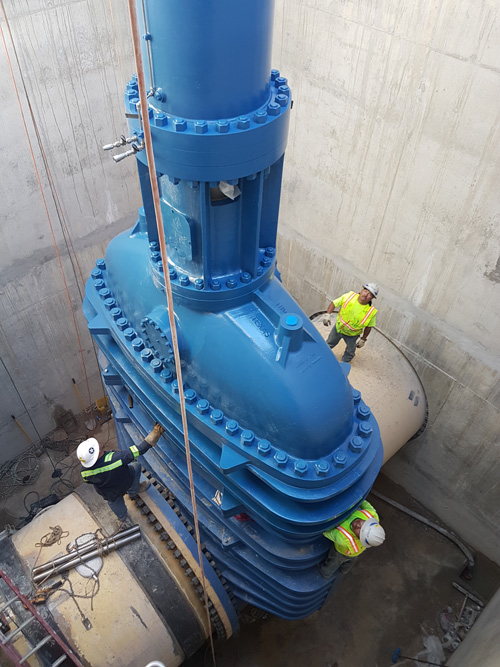
NORITE’s Solution: Standard Flexibility and Global Project Expertise
As a valve brand dedicated to international engineering projects, NORITE offers:
Multi-standard product matrix: Full coverage of EN/AWWA/API/ISO
Selection guidance service: Recommend standards based on the location and working conditions of the customer’s project
Customer Interface Verification Toolkit: Avoid on-site installation errors
Successful project delivery experience in regions such as Spain, Saudi Arabia, Colombia, and Indonesia
Standard conversion adaptation: Supports customized interface flange transitions between EN-AWWA and ISO-API

Conclusion + CTA: Make Standard-Based Selection Smarter
Standards are not obstacles but Bridges to ensure the success of projects. Behind the selection process lies the entire chain of understanding requirements, matching standards, and ensuring operation. NORITE is committed to being your standardized partner in global projects, helping you avoid pitfalls and make professional choices.
Contact us immediately to obtain the NORITE standard adaptation solution and project recommended models.






